Monday, November 7, 2022

Gentrification In Los Angeles


Gentrification In Los Angeles

By: Vanessa Rodriguez

Mural by: Doug Chayka: https://dougchayka.com/Stop-Gentrificationh


“Civic engagement refers to the ways in which citizens participate in the life of a community in order to improve conditions for others or to help shape the community’s future.” In my own terms, civic engagement in my own definition is being involved in a community in order to gain skills and knowledge to help solve real-life issues around us in order to make it a better place. My social issue in my community is gentrification. This is important to me because the way gentrification is happening right now is unfair to the community in so many ways. Not just my community but some of my close friends and family. It is sad to see how this is affecting our lives and not for the better. 
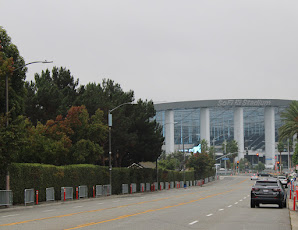


The City of Champions as many know is Inglewood.  

Growing up in Inglewood I was able to learn to love 

my community being that everyone practically knew 

each other and the majority of my life was in Inglewood

from going to school there, the parks, local business 

owners, and more. I can most definitely say this city 

has become a big part of my life. I was ready to see

changes but not changes that impacted our community

 heavily. Over the past couple of years, there have been 

quite a few. I would admit they are nice changes but not 

so nice at the same time. It does have negative outcomes

for the community. They are negative to us because it does 

not benefit us nor help our families. It kicks residents out of their 

homes, having nowhere to go and barely enough time to look for a new home. As well as business having to shut down due to the projects that are being created


What is Gentrification:

Gentrification can be defined as, “Economic and social changes that are a result of an influx of higher-income residents and housing investment. Also characterized by the displacement of lower-income residents as housing stock values rise.” Gentrification can be both negative and positive. Positive gentrification would be the city making adjustments that need to be made such as making the community nicer being that gentrification tends to happen in low-income cities. Other positives of this are new homes being built, economic opportunities, and an increase in property value. Cities do become cleaner, nicer, and more comfortable for the community giving them quite a few benefits but as mentioned they do have their negatives as well. Gentrification is often portrayed as a double-edged sword (Svaldo, 2016). Urban areas are becoming modern making it a problematic process for the community from the social construction that has a huge impact between social classes. It is pushing out socioeconomically residents which then causes social conflicts that lead to possible protests because of changes being made which again is gentrification. 


Linda Moreno

“ So far what I have experienced with gentrification has been my rent rising as well as seeing my community change. I see my family and close friends go through gentrification. I’ve seen apartments that have gotten remodeled and the rent just increasing to the point where the people living cannot afford it. One of my close friends was getting paid to move out of her apartment but what they were paying her was not enough for a home or for her to find a new place to live. They are changes but not for the better when it comes to people not being able to afford to live in the community that they’ve grown up in. The apartments I live in are all I know and now that they are changing it doesn’t feel like home.”

How Gentrification Affects people? 

Gentrification affects the community by forcing residents to move out of their homes leaving them nowhere to go and potentially leaving families homeless. Due to the cost of living rising families are unable to afford to live in their own community anymore. It is not affordable to them. Let’s also not forget how projects such as sports stadiums, venues, and the construction of homes or malls. A Hollywood journal stated, “The area is also changing in other, complicated ways. While housing sales and development boom, led by the construction of SoFi Stadium in nearby Inglewood, a number of grocery stores have closed during the pandemic, creating food deserts for the growing population. A $2.14 billion Metro line, running from Crenshaw to LAX, is expected to open in 2022, which will make the area accessible to a whole new group of commuters; already more than 16 housing and retail projects are planned along its route.”  These luxury housing and attractions allow people from middle-class and upper class to move into these lower-class cities making it quite uncomfortable for those in the community because they are being forced out to welcome these upper class when families have been living there their whole lives. 


Diego & Hervy


Diego 

“ Growing up having to move to an even lower income area when where I lived was already low income was quite stressful and overwhelming. Living close to a venue like the Forum, prices went up, as well as making the surroundings of the city nicer but being that apartments are and were being remodeled makes property value and rent rise. Being able to live within walking distance of the venue and having to go home can get frustrating when it is taking longer than it normally would. We already have to struggle with LA traffic and now traffic in the streets because of the games or concerts. It is truly unfair to the community.” 


Hervy

“ The very first time I saw gentrification was back in Chicago, the Cabrini Green projects that were torn down and made into these fancy new condos that went for about three thousand dollars. I see gentrification in most major cities and even across the nation. Changes in neighborhoods are being made and in my neighborhood too. Having the upper class move into low-income cities is becoming normal now. The way I feel about it is not okay, and it is wrong. Taking people out of their homes to relocate them because they can’t afford it due to their rent rising is just wrong.


Overall what I have learned from this project is that gentrification can be both good and bad. Gentrification can help improve on making these low-income cities into nicer middle-class places for people to live in by having modern homes and buildings. Making it safer and cleaner for everyone but the negative of gentrification for me really outweighs the positive. It is extremely unfair and unjust to me that the way it is done sometimes is not for the better of the community but more for the city and the money it can potentially bring. I feel as if they leave out those who make or even made that community and city. Taking away someone's home where they grew up and seeing it transform into a place you don’t even recognize anymore can be sentimental. People have memories and love for their cities just for them to be taken from. Sometimes we don’t have much control over gentrification but we as a community can most definitely make a change and stand up for each other and our homes. We are all facing this social issue and not just us but family and friends as well. 


References : 


Adler , R. P., & Goggin, J. (2005, July). A global force. A global force | International Programs | University of Nebraska Omaha. Retrieved October 26, 2022, from https://www.unomaha.edu/international-studies-and-programs/_files/docs/adler-goggin-civic-engagement.pdf

Christafore, D. (2018, September 27). Neighbourhood inequality spillover effects of gentrification. Retrieved October 25, 2022, from https://rsaiconnect-onlinelibrary-wiley-com.mimas.calstatela.edu/doi/full/10.1111/pirs.12405

Chuba, Kirsten. "South Los Angeles has 'Gotten Very White': Tiffany Haddish, Issa Rae and Kemp Powers talk about the rapidly changing, historically Black area, where home prices are spiking and development is on the rise: 'A blessing And a curse'." Hollywood Reporter 25 Aug. 2021: 40+. Business Insights: Global. Web. Retrieved October 26, 2022, from https://bi.gale.com/global/article/GALE%7CA675821528/cfbbf21308a1cdce627cd34d37f1620a?u=calstate

 Fong, Polly et al. “Neighbourhood Identification Buffers the Effects of (de-)gentrification and Personal Socioeconomic Position on Mental Health.” Health & place 57 (2019): 247–256. Web.

https://csu-la.primo.exlibrisgroup.com/discovery/fulldisplay?docid=cdi_proquest_miscellaneous_2231851672&context=PC&vid=01CALS_ULA:01CALS_ULA&lang=en&search_scope=MyInst_and_CI&adaptor=Primo%20Central&tab=MyInst_and_CI&query=any,contains,social%20and%20economical%20gentrification%20negatives&facet=searchcreationdate,include,2019%7C,%7C2022&offset=0

Schnake-Mahl, A. S., Jahn, J. L., Subramanian, S. V., Waters, M. C., & Arcaya, M. (2020, February). Gentrification, neighborhood change, and Population Health: A Systematic Review. Journal of urban health : bulletin of the New York Academy of Medicine. Retrieved October 25, 2022, from https://www.ncbi.nlm.nih.gov/pmc/articles/PMC7010901/#:~:text=and%20Maroko%202014-,Gentrification,as%20housing%20stock%20values%20rise


Mental Health in Lower-Income Communities

 Mental Health in Lower-income Communities

Research

What is mental health?


Throughout the years' mental health has become more prevalent, as we as a society talk about it more people are becoming aware that it is more common than thought.  There are different types of mental health emotional, psychological, and social well-being. There is a different factors that can contribute to mental health issues such as biological factors, life experiences, and family history. As science advances so are early dictation, some symptoms can be diagnosed earlier. This is why it is important to have mental health resources readily available throughout each community.

Can certain mental illnesses be prevented?


At this time there is no sure way to prevent mental health issues, but there are ways to cope and help control symptoms. Having resources available is very important to have throughout the community not just for kids, but also for the parents and adults throughout the community. If mental health illnesses go untreated they can lead to disabilities and cause severe emotional, behavioral, and physical health problems. Some complications can lead to personal issues such as family conflicts or relationship isolation, while other complications can lead to issues that affect the community such as homelessness and violence. Unfortunately, many mental health aids or resources are underfunded or non-existent in lower-income communities where it is needed the most.

How does low income affect mental health?


There is a disparity when it comes to mental health help and resources from community to community, unfortunately, lower-income communities or communities with a majority of Latinos/Hispanics or blacks get the short end of the stick. There has been researched that correlates poverty to overall well-being, both physical and mental, in young children. There is also a cultural stigma when it comes to mental health, especially in Hispanic/Latino communities, which prevents many parents and individuals from getting or receiving help. There is also a need for educational resources to help explain and debunk myths about mental health. Having more information and resources within the community, that are free and accessible to all would help improve the well-being of the entire community.

Personal

In my household, we never discussed any issues concerning mental health even after my older sister was diagnosed with bipolar and depression. It was due to the stigma that our culture creates around mental health. In our culture people do not want to be classified are crazy or lazy. An example of this is the symptoms of depression can be seen as just being lazy, most older Latinos and other minorities do not take it seriously.  I have always just dealt with my anxiety and stress by just ignoring it and trying to downplay it. It was until this past winter when I was working a full-time job and going to school full time that it just became too much for my body. During one of our busiest times of the year, I had an anxiety attack at work and I felt completely vulnerable. Fortunately, I have insurance and my primary care doctor helped me get help to cope with my anxiety. If at an early age I would have been able to talk to those around me or felt comfortable talking about it, I feel my attack could have been prevented.

What can improve

I feel that providing more resources to underprivileged communities could help everyone in that community and surrounding areas. It would improve the well-being of many families, lower crime rates, and lower homelessness. Having resources available within a community like educational classes in different languages, access to counselors, and therapy groups, not just in school but open to the public can save many lives.

Community Members Thoughts

Micaela


There are not enough mental health resources in our community as mental health is often undervalued in Latinx/Latine communities. Mental health should be destigmatized and communities should be able to hold healthy communication and avoid dismissing mental health issues. I think culture does play a role because most Latinx/Latine parents don’t like discussing their feelings or often bottle them up. Additionally, machism runs rampant in Latine/x communities so it could be seen as “unmanly” to discuss feelings and mental health struggles.

Brittney


There are not enough resources within my community, and being a parent there is a struggle to find the right help for my kids. Having more resources locally, especially accessible for kids starting in elementary and extended to the family would be such a great help. This would help me with how I can help my own kids. 

Rosie


I have seen the difference in the number of resources from one community to another, living in a lower income it was hard to get access to any mental health resources. After moving into my new community, I have noticed how much aid is offered and available not only to my children but to me as well. As a Chicana, I think culture does play a role in it. Some families may not believe in mental health/mental illness until perhaps it's something severe and does not take action to care for their loved ones. I want that to change with me and my family, I want my family to be both physically healthy and mentally healthy. 


Sources 

https://www.cdc.gov/hrqol/wellbeing.htm

https://www.ncbi.nlm.nih.gov/pmc/articles/PMC5192088/

https://www.mayoclinic.org/diseases-conditions/mental-illness/symptoms-causes/syc-20374968#:~:text=other%20medical%20conditions-,Prevention,keep%20your%20symptoms%20under%20control


Misinformation in Science

Misinformation "can be broadly defined as information that is incorrect, possibly by accident. Disinformation has sometimes been used to denote a specific type of misinformation that is intentionally false." 1(D. Scheufele and N. Krause)

For the purpose of this blog, I will define misinformation as information that is incorrect or false - for simplicity. 


"The repercussions are extensive. Without reliable and accurate sources of information, we cannot hope to halt climate change, make reasoned democratic decisions, or control a global pandemic.(J. West and C. Bergstrom)

This quote perfectly explains why correcting and disputing misinformation is essential. If there is too much misinformation, there will be no significant progress. 


This figure shows the rise of the term fake news used in conversation. We can see that it has risen exponentially. The public has become more aware of false information but struggles to differentiate the incorrect and correct facts.  


There is a big issue with scientific misinformation: the public can get confused about what is real. It directly affects me because it affects the people I care about. Fortunately, I am pursuing a science major. I have learned the skills to detect what is false, and I am getting my sources from professors and primary articles. Therefore, I can teach most of my family members and friends when they are not adequately informed.

Additionally, they mustn't feel ashamed because it is not their fault. Sometimes, I believe the misinformation, and it takes me a while to find the correct facts. Occasionally, we would talk about a topic, and they will bring up false information they had read. While generally, it is not a big issue, it can be when it revolves around health, where they may not want to get a vaccine because it may cause autism or because it is fake, when that is not the case.

I choose this issue because it is an issue that is not talked about often except in my academic setting. I believe it is essential to inform the public so they become aware, look for the misinformation, and dispute it so that the public will not be confused. Additionally, as society becomes more advanced, there will be many articles and new jargon that the public will be confused and the public will believe false information. Therefore, it is easier to accept new changes if there is less incorrect information. 


Matthew Carbajal

"As a member of the post-bac biotechnology program here on campus, I truly feel insulted when people do not believe in science. Occasionally, non-science believers will make me feel that the work I put into completing my degree was worthless and purely fiction. I believe that misinformation in science is detrimental to all those in the healthcare and research communities, and those that spread false information can negatively impact scientific progress."


Sources:

    Articles:

1. https://www.pnas.org/doi/10.1073/pnas.1805871115#abstract

2. https://www.ncbi.nlm.nih.gov/pmc/articles/PMC8054004/

    Picture: https://knowledge.wharton.upenn.edu/article/rothschild-project-ratio/

    Figure 1: https://www.pnas.org/doi/10.1073/pnas.1805871115

The School-to-Prison Pipeline

 The School-to-Prison Pipeline


Key Terms:

  1. Mass Incarceration - Term coined by David Garland in 2000 to describe the expansion of imprisonment in the U.S. between 1975 to the late 1990s. (But still relevant and happening today!) 


  1. School-to-Prison Pipeline - The ACLU defines the school-to-prison pipeline as “a disturbing national trend wherein youth are funneled out of public schools and into the juvenile and criminal legal systems.” 


  1. Zero-Tolerance Policies (In schools) - “Zero tolerance refers to school discipline policies and practices that mandate predetermined consequences, typically severe, punitive and exclusionary (e.g., out of school suspension and expulsion), in response to specific types of student misbehavior—regardless of the context or rationale for the behavior,” as defined by the School Discipline Support Initiative 


  1. Criminal Justice System - The system of law enforcement that is directly involved in apprehending, prosecuting, defending, sentencing, and punishing those who are suspected or convicted of criminal offenses, defined by Oxford Languages. 


  1. Prison Industrial Complex - The profit-driven relationship between the government, the private companies that build, manage, supply, and service prisons, and related groups (such as prison industry unions and lobbyists) regarded as the cause of increased incarceration rates, especially of poor people and minorities and often for nonviolent crimes, as defined by Merriam Webster. 


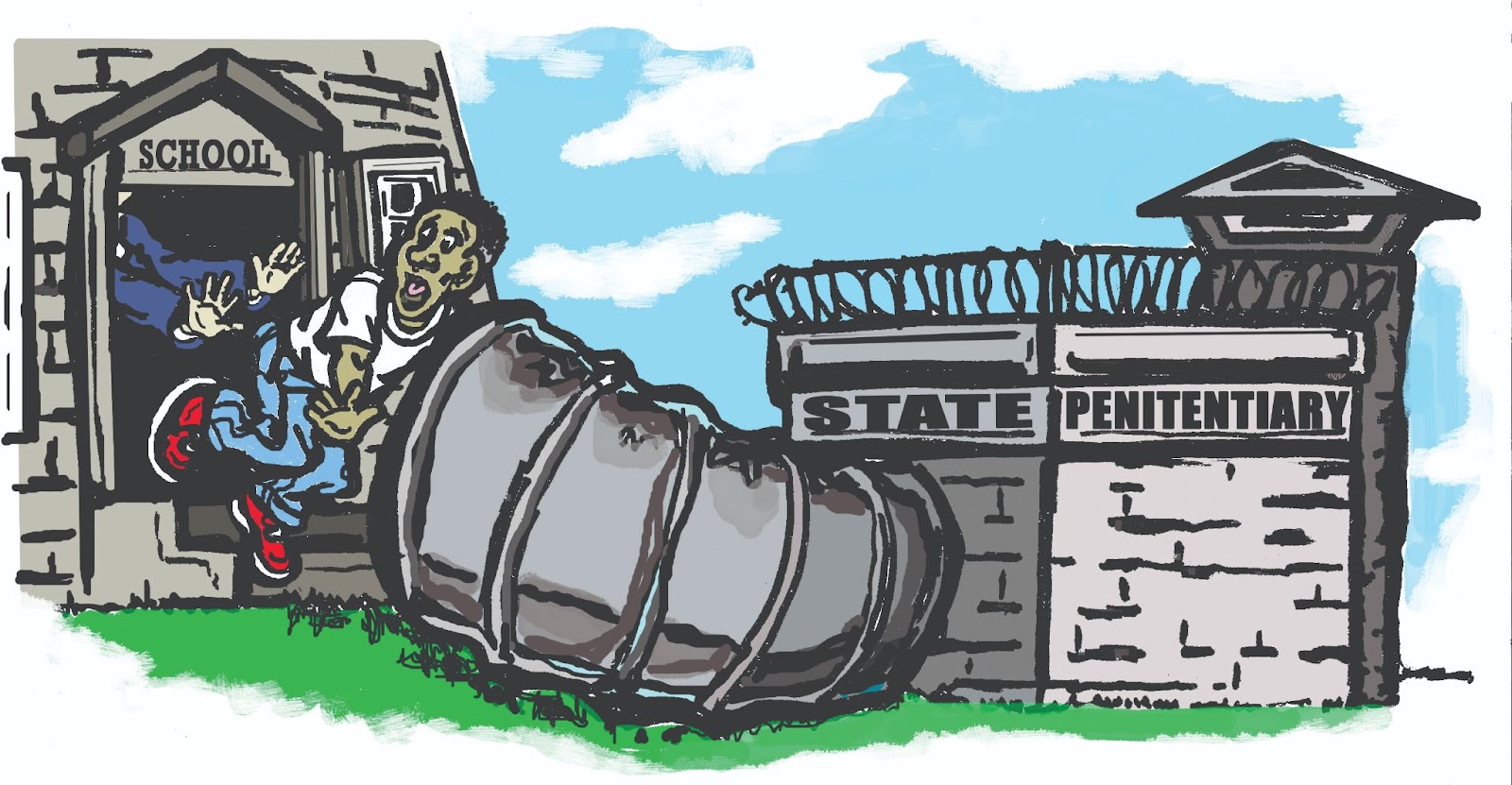
The United States has a long history of both criminalizing and incarcerating youth of color which ultimately leads to the push out of students in schools and into the prison system. Zero-tolerance policies in schools play a large role in this, too, when students of color misbehave and receive no additional opportunities to improve their behavior or actions, thus being called “zero-tolerance.” When schools utilize this method, they actively participate in the school-to-prison pipeline and participate in the country’s prison industrial complex. Another way that schools actively participate in this is by having a heavy police presence on school grounds. While it may seem extreme, this is the reality of students of color, students with disabilities, English-language learners, and is as specific as targeting male students. 

When students are pushed out of their own schools and even encouraged to drop out, they miss a lot of educational opportunities, are criminalized more, and often end up in the criminal justice system, despite being children. When children are criminalized, it is because it stems from a very racist and dated stereotype of people of color being criminals. The reality is that children are children and do not need to be othered, especially by the authority figures in their schools, and this extends to police presence as well. There is no need for campus police specifically for students that “act out” or behave in a way that schools do not like and there are ways that they can improve this behavior if they truly care about their student's well-being such as restorative justice practices. 


In a School-to-Prison pipeline article written by the ACLU, they have found that “Students of color are especially vulnerable to push-out trends and the discriminatory application of discipline,” and this is true because the rates of students of color affected by the school-to-prison pipeline compared to their white counterparts are extremely high.

The ACLU has also found that “Many under-resourced schools rely on police rather than teachers and administrators to maintain discipline. Growing numbers of districts employ school resource officers to patrol school hallways, often with little or no training in working with youth. As a result, children are far more likely to be subject to school-based arrests—the majority of which are for nonviolent offenses, such as disruptive behavior—than they were a generation ago.”

When referring to how costly it is to send youth to prison, the ACLU’s fact sheet on The Juvenile Justice System found that “Both California and Florida currently spend more on corrections than they spend on higher education. Other states are not far behind. [The] Average cost of incarcerating a juvenile for one year is between $35,000 to $64,000.” 

The CDRC (Civil Rights Data Collection), in a Data Snapshot of School Discipline done in 2014, has provided statistics pertaining to suspensions of Black students, “Black students are suspended and expelled at a rate three times greater than white students. On average, 4.6% of white students are suspended, compared to 16.4% of black students.” 

In the same study, the CRDC found that “While black students represent 16% of student enrollment, they represent 27% of students referred to law enforcement and 31% of students

subjected to a school-related arrest… Students with disabilities (served by IDEA) represent a quarter of students arrested and referred to law enforcement, even though they are only 12% of the overall student population.” 


In a report made by The Civil Rights Project conducted by Harvard University, “Zero tolerance policies, by their nature, do not provide guidance or instruction. Frequently, because these policies focus directly on harsh forms of punishment, which are inherently unjust, they breed distrust in students toward adults, and nurture an adversarial, confrontational attitude.” 

“As a result of Zero Tolerance policies, children are being increasingly subjected to criminal or juvenile delinquency charges.


As stated, the school-to-prison pipeline is something that heavily affects and actively targets low-income students and youth of color, which is why I decided to choose this issue. I come from a low-income community myself and have witnessed my own peers and friends go through this devastating system as early as 12 years old. It is something that is so scary to see and has resulted in me researching this topic and advocating for the abolition of the pipeline, as well as the prison system. I have seen police in my schools, I have seen the Los Angeles Unified School District have access to weapons, and I have seen my classmates go to juvenile detention centers and be escorted out of school by police; I can only imagine what parents of these children have experienced. It is so heartbreaking to hear that minority students are often profiled and targeted not only by local police but by their own school administrators or teachers that encourage them to drop out and leave their academic careers for something that continuously harms the students and their communities. 

I first researched the school-to-prison pipeline in high school (2016 to be specific), when I was taught the meaning of it in an Ethnic Studies class, and participated in a civil rights/social justice club. Since then, I have done extensive research and it has become a topic that I am extremely passionate about and will always talk about when given the opportunity. I believe that zero-tolerance policies do not serve any positive purpose and reinforce the school-to-prison pipeline due to how strict and harsh the policies are towards children. I believe that schools should get rid of campus police if their only intent is to harm their students. I believe that students deserve more chances and that schools need to implement practices that do not punish but reach out to the student to see what they may be dealing with. I believe that students and youth of color in low-income communities deserve equal educational opportunities and funding for youth resources. 


Community Members: Jose Ayala, Citlalli Martinez, Isaias Flores


“I think that students deserve to be seen, instead of thrown into a system that treats them unfair and puts them at a disadvantage.” - Jose Ayala


Citlalli Martinez states, “Students are pushed out and create a cycle of school-to-prison, schools need to do better.” 


Isaias Flores states, “Children should be allowed to be children, they don’t need to be criminalized. What they need are resources readily available instead of being expelled.” 


References


 Zero tolerance: School discipline support initiative. Zero Tolerance | School Discipline Support Initiative. (2020). Retrieved November 1, 2022, from https://supportiveschooldiscipline.org/zero-tolerance-policy#:~:text=Zero%20tolerance%20refers%20to%20school,or%20rationale%20for%20the%20behavior


Police presence in schools. American Civil Liberties Union. (2022, February 15). Retrieved November 3, 2022, from https://www.aclu.org/issues/juvenile-justice/juvenile-justice-school-prison-pipeline/police-presence-schools 


 “Prison industrial complex.” Merriam-Webster.com Dictionary, Merriam-Webster, https://www.merriam-webster.com/dictionary/prison%20industrial%20complexAccessed 3 Nov. 2022.


ACLU fact sheet on the Juvenile Justice System. American Civil Liberties Union. (n.d.). Retrieved November 3, 2022, from https://www.aclu.org/other/aclu-fact-sheet-juvenile-justice-system 


U.S. Department of Education Office for Civil Rights, Issue Brief Civil Rights Data Collection: Data Snapshot, school discipline1–7 (2014). Retrieved November 3, 2022, from https://ocrdata.ed.gov/assets/downloads/CRDC-School-Discipline-Snapshot.pdf


The Civil Rights Project. (2000). (rep.). Opportunities Suspended: The Devastating Consequences of Zero Tolerance and School Discipline (pp. 6–7).  Retrieved November 1, 2022, from https://civilrightsproject.ucla.edu/research/k-12-education/school-discipline/opportunities-suspended-the-devastating-consequences-of-zero-tolerance-and-school-discipline-policies/crp-opportunities-suspended-zero-tolerance-2000.pdf 


Rights Behind Bars

 RIGHTS BEHIND BARS

By: Saul Dominguez

 Civil Engagement

  • My look into Civil Engagement is engaging in the community, to help support one another in a variety of skills to help and address civic issues.You probably see the news, media, even social media and see court discussions about liberty restrictions towards felons, and think to yourself, what’s the whole point of letting them free, if their civil rights have been taken away and not restored.

The Problem : 

  • Ex-Felons completing their sentences, should have the rights to vote. President Obama stated as he’s one of the first presidents to enter a federal prison, he agrees people do mistakes, as he states the right thing to do is to serve time and once out he stated he believes it’ll “[increase] the possibility that they can turn their lives around” Once felons serve time, if their get rights to vote, something small like that can bring them closer to the community than to be dehumanized.

  • Losing civil rights is inhumane to people. S. David Mitchell, JD, Scholar in Residence at the University of Colorado Department of Sociology, stated once that Ex-felons disenfranchisement should be allowed, and could affect their citizenship. Disenfranchisement means the right and privilege to vote, and although many are restricted in many ways post prison, by all means they shouldn’t lose their civil rights since it violates their freedom of speech.

The Solution :

  • Proposal 2, a solution in which restore vote rights can be given towards felons, regarding issues, not related to the offense committed. 
    Ex-Felons should be allowed to vote but to a certain extent, they could be given the same voting requirements, but issues that relate to a crime committed by the felon can be restricted.

  •  This solution will benefit them, in “Are Felon Disenfranchisement Laws a Form of Racial Discrimination?” The article states, since not allowing ex-felons to vote, it disrespects the rule of law. Importantly this can help strengthen the community and eventually help bring responsibility and a sense of hope towards ex-felons, up lifting their community and importantly themselves.

Personal Antedote:

Growing up in a minority household, we often know someone close to us who's been a felon, or is still serving time. Well for me pe
rsonally, one of my close family members has been a felon, served time and still till this day faces limited rights after many settled court dates. In my community, the number of felons is common especially in Los Angeles, where the majority of my community come from black and brown communities.  First I will talk about Felons having their rights taken away, then the reasoning if they had the ability to vote they’d become biased, and the solution to have felons vote regarding issues that are not related to the offense committed. Going out to my community, i asked neighbors and friends who related or knew a person that was dealing with this situation and was quite surprised how many had similar opinions on restoring voting rights.

Interviews:

Maria Ramirez "They should be able to vote because whatever personal issues they have should be different from personal opinions, one thing shouldn't affect the others. This affects me personally because since i have a daughter that is an ex-felon, and she is limited on most of her rights and one of them being a political issue is what affects her the most, but in the end of the day these are adults with knowing their consequences."

Maria, a mother and grandmother of 3, living in south central, used to the environment in minority groups and her daughter in which she mentions is also affected by the issue.

Summary: