Tuesday, November 3, 2020

Rafael Vazquez - Obesity

 Obesity

Rafael Vazquez

California State University, Los Angeles

Art 3170-01

Professor Aziz

November 2, 2020


  • What is Obesity?

    Obesity is a complex disease when an individual has an excessive amount of body fat that increases the risk of health problems. It often occurs when a person overeats a lot by intaking more calories consumed, rather than burned by exercise and normal daily living activities. There are reasons why it is difficult for people to not be obese due to lack of exercise and eating malnutrition foods, according to an article on Obesity (Mayo Clinic, 2020).


Research: Facts on Obesity

  • How can obesity affect you?
  • According to the CDC of obesity, obese people have a higher chance of having severe medical problems (Mayo Clinic, 2020).
    • Type 2 Diabetes
    • Hypertension (high blood pressure)
    • It can cause heart attacks or other heart problems.
    • It can cause swollen feet, ankles and develop lymphodemas in any part of the body,
    • Digestive problems
    • Sleep apnea (difficulty breathing while sleeping).
    • Certain cancers and other major health problems.
    • High cholesterol levels

  • What are the reasons that can cause obesity?
  • According to the CDC for obesity, there are many reasons why many Americans struggle to lose weight or not be obese. Obesity happens from a combination of causes and contributing factors. (Mayo Clinic, 2020). 
    • 1. Family inheritance. It is not uncommon that obesity can be inherited from people's parents. The reason is that genes can play a role in obesity because your body can affect the amount of body fat you store and where the fat can be distributed in the body. Obesity also has to with that it runs in the family, not just because of the genes people share from their parents/family; it has to do with family members sharing similar eating and activity habits. 
    • 2. Lifestyle choices. 
      • Unhealthy diet. Eating foods that contain high-calorie meals, such as sweets, fast food meals, lacking healthier foods (fruits and vegetables), and eating oversized portions. These things can cause weight gain, which may lead to a person becoming overweight or obese - if it occurs often.
      • Liquid calories.  It is possible to still consume many calories without eating or feeling feel from drinking beverages with high calories. Consuming too many beverages that contain high calories or sugars, such as sodas, juices, or alcoholic beverages, can increase the chances of gaining weight. 
      • Inactivity. People who live a sedentary lifestyle often have a higher chance of becoming overweight or because. The reason is that they do not exercise or do little no activities, such as daily living activities. It is easier for people with this behavior to consume more calories than burned without doing any exercises or activities to maintain their weight. For example, watching television, going on your smartphone, computer, tablet, or laying down are all sedentary behaviors. All of these things are highly associated with weight gain. 
    • 3. Social and economic issues. Social and economic problems are linked to obesity. The reason is that there are people in low-income communities that do not have access to healthier foods, have been taught to cook healthier meals, or can only afford to buy foods that non-healthy. It can also be spending time with family and friends, where those influences can lead people to gain weight and have health problems. 
    • 4. Age. Obesity can occur at any age, whether a person is young or not. As people get older, their muscle mass will begin to decrease, slowing down your metabolism. It makes it difficult to lose weight. Also, by not controlling your eating habits and exercising less as you age, the chances of becoming obese are high.
    • 5. Other factors.
      • Pregnancies can cause weight gain.
      • Stress from work, school, or other problems.
      • Lack of sleep, whether is not getting enough sleep or too much sleep can lead to weight gain. 
      • Previous attempts to lose weight.
Infographic about the causes of obesity. Obesity can be caused by lack of exercise, food choice, health conditions, and genetics.


Obesity: Facts and Statistics
  • Statistics: Who is more affected by obesity men or women?
What was the prevalence of obesity in adults in 2015–2016?
The prevalence of obesity among U.S. adults was 39.8% (crude). Overall, the
prevalence among adults aged 40–59 (42.8%) was higher than among adults
aged 20–39 (35.7%). No significant difference in prevalence was seen between
adults aged 60 and over (41.0%) and younger age groups (
Figure 1
).
Figure 1. Prevalence of obesity among adults aged 20 and over, by sex and age: United States,
2015–2016
1
Significantly different from those aged 20–39.
NOTES: Estimates for adults aged 20 and over were age adjusted by the direct method to the 2000 U.S. census population using
the age groups 20–39, 40–59, and 60 and over. Crude estimates are 39.8% for total, 38.0% for men, and 41.5% for women.
Access data table for Figure 1 at: https://www.cdc.gov/nchs/data/databriefs/db288_table.pdf#1
.
SOURCE: NCHS, National Health and Nutrition Examination Survey, 2015–2016.
Percent
20 and over
20–39
40–596
0 and over
To tal
Men
Wo
men
50
40
30
20
10
0
35.7
1
42.8
41.0
37.
9
34.
8
1
40.
8
38.5
41.1
36.5
1
44.7
43.1
39.6
What was the prevalence of obesity in adults in 2015–2016?
The prevalence of obesity among U.S. adults was 39.8% (crude). Overall, the
prevalence among adults aged 40–59 (42.8%) was higher than among adults
aged 20–39 (35.7%). No significant difference in prevalence was seen between
adults aged 60 and over (41.0%) and younger age groups (
Figure 1
).
Figure 1. Prevalence of obesity among adults aged 20 and over, by sex and age: United States,
2015–2016
1
Significantly different from those aged 20–39.
NOTES: Estimates for adults aged 20 and over were age adjusted by the direct method to the 2000 U.S. census population using
the age groups 20–39, 40–59, and 60 and over. Crude estimates are 39.8% for total, 38.0% for men, and 41.5% for women.
Access data table for Figure 1 at: https://www.cdc.gov/nchs/data/databriefs/db288_table.pdf#1
.
SOURCE: NCHS, National Health and Nutrition Examination Survey, 2015–2016.
Percent
20 and over
20–39
40–596
0 and over
To tal
Men
Wo
men
50
40
30
20
10
0
35.7
1
42.8
41.0
37.
9
34.
8
1
40.
8
38.5
41.1
36.5
1
44.7
43.1
39.6hat was the prevalence of obesity in adults in 2015–2016?
The prevalence of obesity among U.S. adults was 39.8% (crude). Overall, the
prevalence among adults aged 40–59 (42.8%) was higher than among adults
aged 20–39 (35.7%). No significant difference in prevalence was seen between
adults aged 60 and over (41.0%) and younger age groups (
Figure 1
).
Figure 1. Prevalence of obesity among adults aged 20 and over, by sex and age: United States,
2015–2016
1
Significantly different from those aged 20–39.
NOTES: Estimates for adults aged 20 and over were age adjusted by the direct method to the 2000 U.S. census population using
the age groups 20–39, 40–59, and 60 and over. Crude estimates are 39.8% for total, 38.0% for men, and 41.5% for women.
Access data table for Figure 1 at: https://www.cdc.gov/nchs/data/databriefs/db288_table.pdf#1
.
SOURCE: NCHS, National Health and Nutrition Examination Survey, 2015–2016.
Percent
20 and over
20–39
40–596
0 and over
To tal
Men
Wo
men
50
40
30
20
10
0
35.7
1
42.8
41.0
37.
9
34.
8
1
40.
8
38.5
41.1
36.5
1
44.7
43.1
39.6

  • According to an article about obesity among children and adults, in the years 2017-2018, there were 42.8% of adults in the United States who were obese between men and women.
  • Adults aged 40-59 (44.4%) reported higher obesity rates than younger adults ages 20-39 (40.0%).
  • Older adults aged 60 and over had obesity rates of 42.8%.
  • It is showed that between men and women obesity followed a similar pattern in age. 
  • Men aged 40-59 (46.4%) had more middle-aged men hat are obese than younger men aged 20-39 (40.3%). Then the data showed 42.2% of males age 60 and above are obese.
  • Women aged 40-59 and 60 and above (44.3%) had more middle-aged women that are obese than younger women aged 20-39 (39.7%).
  • The results showed that there was no significant difference in the prevalence of obesity between men and women.

Figure 1. Prevalence of obesity among adults aged 20 and over, by sex and age: United States, 2017–2018
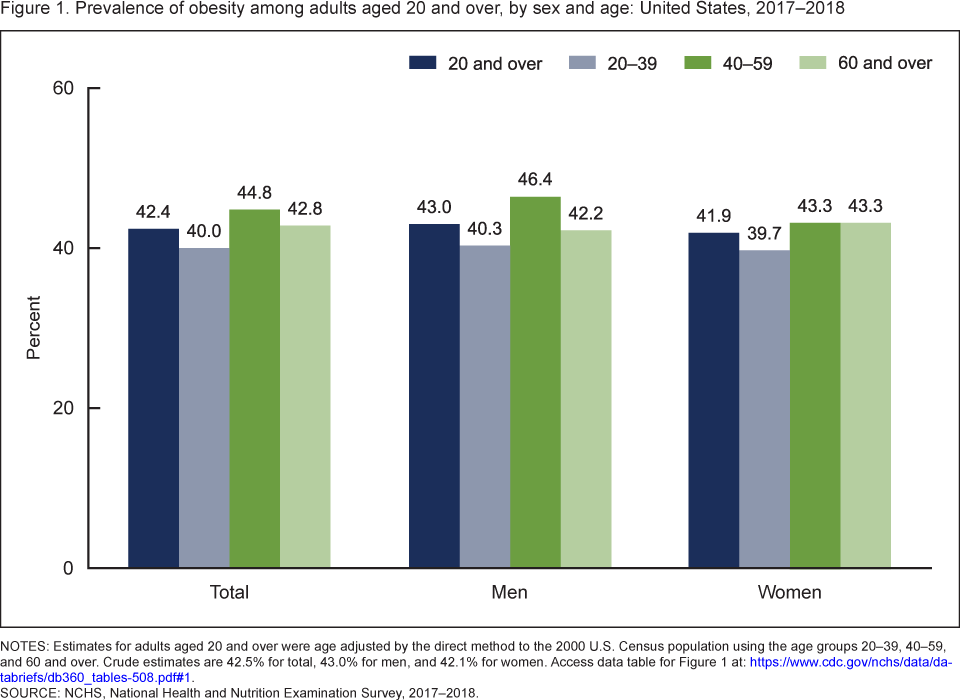

image icon
Figure 1 is a bar chart that shows the prevalence of obesity among adults aged 20 and over, by sex and age, in the United States from 2017 through 2018.image icon.

  • Statistics: Obesity based on Races
  • The graph shows that Non-Hispanic Asian adults reported 17.8%, which is the lowest obesity rate for all races in the years 2017-2018 in the United States.
  • In 2017-2018, it was reported that non-Hispanic blacks report the highest percentage (49.6%) of adults in the U.S. that are obese. 
  • In 2017-2018, Hispanic adults had the second-highest percentage for obesity (44.8%) of adults. Then non-Hispanic Whites had 42.2% of adults in the U.S. that were obese.
  • For males, it was reported that the race with the lowest prevalence of obesity was Asians (17.5%), compared to White males (44.7%), and Black males (41.1%). It was reported that Hispanic males that the highest percentage of obese males (45.7%) in the years 2017-2018.
  • For females, it was reported that the race with the lowest prevalence of obesity was Asians (17.2%), compared to White females (39.8%), and Hispanic females (43.7%). It was reported that Black females that the highest percentage of obese females (56.9%) in the years 2017-2018.
  • Overall, it showed that Black females had a higher prevalence of obesity than Black males.

Figure 2. Age-adjusted prevalence of obesity among adults aged 20 and over, by sex and race and Hispanic origin: United States, 2017–2018
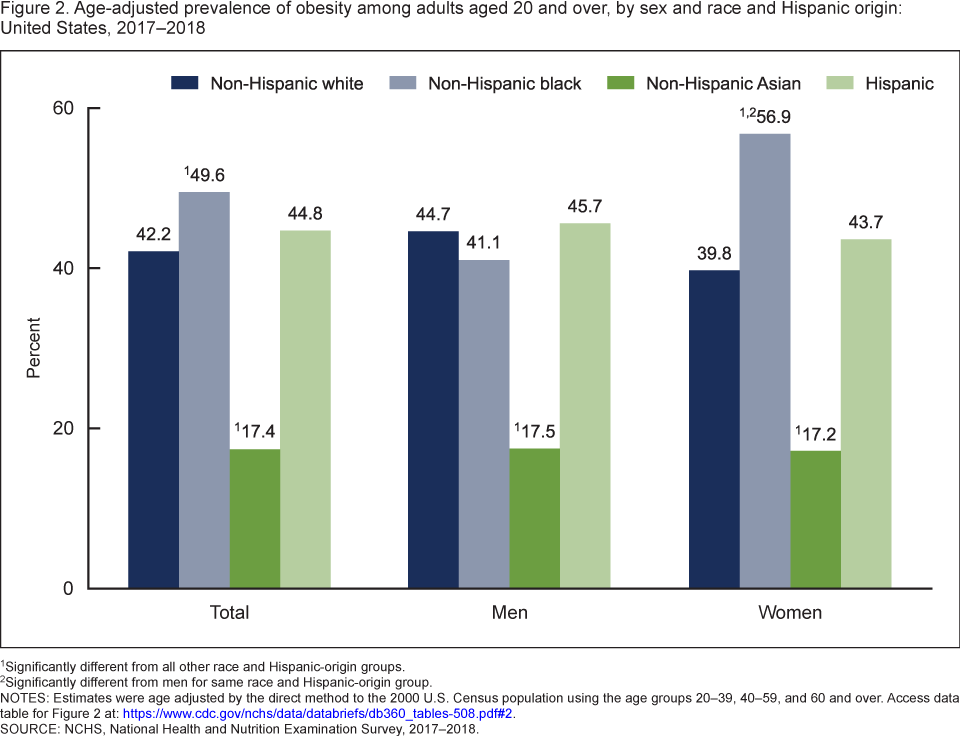

image icon
Figure 2 is a bar chart that shows the age-adjusted prevalence of obesity among adults aged 20 and over, by sex and race and Hispanic origin, in the United States from 2017 through 2018.image icon

  • What can we do to prevent or stop this issue? 

  1.  Eat three meals a day without snacking in between, if possible.
  2.  Engage in regular aerobic activity by exercising at moderate (75 minutes) or vigorous (150 minutes) intensity. 
  3. Avoid eating unhealthy foods at night (it is harder to burn calories because you will soon fall asleep).
  4. Drink plenty of water and avoid sugary beverages.
  5. Make sure to get plenty of sleep, both children and adults.
  6. Help the lower-income communities have access to healthier foods at more affordable prices.

Personal Reflection:

  • How Obesity Affects Me

    The obesity issue affects me because many of my community members and extended family members are obese. Living in a low-income community affects many people. They cannot afford to buy healthy foods, have access to healthier foods at their local grocery stores, and other things. It also affects me because I am Mexican-American, and most of the foods we eat are unhealthy. Earlier in my college years, I was almost obese because I did not take care of myself. Growing up, I was very active and did Cross Country, Swimming, and Track. I ate l whatever I wanted because I would burn off those calories I consumed and felt good about it afterward. However, once I graduated from high school, I no longer participated in sports or physical activities. I quickly began to gain weight after I had graduated from high school. Once I started college, I continued having poor eating habits with little to no physical activities. It affected me because I would stress out a lot about school and had other issues going on at the time. I would eat out a lot and not pay attention to what I was eating. After my first year in college, I had gained a lot of weight and was classified as overweight. It was the first time in my life where I was not in the healthy category. One day I looked in the mirror and realized how big I had gotten and couldn't fit into most of my clothes. I was almost obese and realized that I could have had major health issues at a young age if I continued to gain more weight. However, one day I decided to change that and cut back on sweets, unhealthy foods, sugary drinks, and exercising more. I started feeling better about myself and quickly lost weight and then back to being 'normal.' The reason obesity is important to me is that I have some family members, neighbors, and other people I know who are obese and have health issues. Although we are aware of our bad choices and see ourselves struggling with this, most of us do not change it for the better until it is too late. Losing weight or at least changing your eating habits is easier said than done. However, it does not mean that impossible to overcome this. I also feel that we trap ourselves in a negative mind and say, "I can't do this - it's too hard." It also affects our self-esteem and confidence; the more we do not do anything about it, the worse it will get. 

  • Why did I choose this issue?

   I chose this topic because I see it a lot in my community and have extended family members affected by it. I wanted to know more about why obesity affects many people in low-income communities and the U.S. Also, I wanted to see how much obesity rates have increased over the past few decades in both the city of Los Angeles and the U.S. I believe it is important for people to understand that obesity is a serious health issue, both mentally and physically. People are always on the go and find themselves picking-up fast food meals, junk food, etc. because it is quick and easy rather than make healthier homemade meals. Something needs to be done to help people in low-income communities and other people struggling to help them live healthier lifestyles. It is not only educating people about how eating healthier foods and exercising can help prevent serious health problems - it is about giving them access to healthier foods at affordable prices and encouraging them to get out and some aerobic activities. We need to be aware that obesity is affecting California residents and affecting many people in the U.S. Obesity is a serious problem across the country because many people do not take care of themselves. 

References

Biggers, Alana. (2018). How to prevent obesity in kids and adults. Healthline. Retrieved from

        https://www.healthline.com/health/how-to-prevent-obesity#prevention-for-adults

Craig M. Hales, M.D., Margeret D. Carroll, M.S.P.H., and Cynthia L. Ogden, Ph.D. (Feburary 2020).     Prevalence of obesity and severe obesity among adults: United States, 2017-2018. National Center for Health Statistics. https://www.cdc.gov/nchs/products/databriefs/db360.htm

Mayo, Clinic. (2020). Obesity - symptoms and causes. Mayo Foundation for Medical Education and  

     causes. Retrieved from

      https://www.mayoclinic.org/diseases-conditions/obesity/symptoms-causes/syc-20375742

Monday, November 2, 2020

Ashley Kim- Fair Housing

 Fair Housing 

     By Ashley Kim


Why Does Fair Housing Matter?

Finding and securing a proper home is important to anyone living in California. Housing affects our lives in many way and determines our access to resources such as education, work, recreation, and food. This has impacted my community personally as rent is costly in my area. I noticed especially during the holidays, residents in my apartment complex are almost always behind on rent. Every year the bank comes to my house to determine to either keep the cost of rent as is or to raise by what amount they determine. It is distressing to think about the possibility of losing your home. The cost of living is determined by the economic state of California, this is very worrisome due to our current state of our economy and it's constant change. 

 The Fair Housing Act

The Fair Housing Act prohibits landlords, real estate companies, banks, and homeowners insurance companies from making homes unavailable to persons based on race, sex, religion, origin, family status, and disability. Individuals who believe that they are victims of illegal housing practice can file a complaint with the Housing Department of Urban Development (HUD) or file a lawsuit in a state or federal court on their own accord. 


Factors that Affect Fair Housing

Banks or Mortgage Loaners often practice "Redlining", Which is denying credit worthy applicants a housing loan in certain neighborhoods. This is a presumed practice that Mortgage lenders draw red lines around portions of a map that indicate areas or neighborhoods where they do not make loans. In the early 1930s, this practice was used to segregate African Americans from White areas. From my knowledge of my previous class in Psychology of Class and Race, this practice is difficult to prove and housing applicants can still be denied based on their income or credit. Some scenarios are obvious when the applicant can afford a home, but can be passed on an offer by another applicant without reason. 

Realtors or Real Estate Agents sometimes practice "Steering" which is an attempt to guide buyers away from or towards a neighborhood or area. This is also hard to prove because a Real Estate agent can simply refuse to show available real estate or make homes unavailable. In addition, it is hard to distinguish whether a real estate agent is advising a prospective buyer or have other underlying motives.

Housing Today

During the pandemic many people have lost their homes due to the economic impact of California. Trump has repealed the fair housing rule this year and has weaken the progress of establishing equal housing opportunities. I want to raise this awareness to my community members and Angelinos that homelessness is becoming a concern in California during these vulnerable times. Housing is becoming more challenging to obtain. Below is a link of a few Covid-19 Housing to have an idea of how the pandemic has impacted people. I hope everyone stays safe during this pandemic. 


References

https://www.justice.gov/crt/fair-housing-act-1#:~:text=The%20Fair%20Housing%20Act%20prohibits%20municipalities%20and%20other%20local%20government,Act%20makes%20it%20unlawful%20%2D%2D

https://www.npr.org/2017/05/03/526655831/a-forgotten-history-of-how-the-u-s-government-segregated-america

https://www.federalreserve.gov/boarddocs/supmanual/cch/fair_lend_fhact.pdf

https://digitalcommons.law.utulsa.edu/cgi/viewcontent.cgi?article=1395&context=tlr

https://nlihc.org/resource/trump-administration-eliminates-affirmatively-furthering-fair-housing-rule-nlihc-and-other

https://www.npr.org/2020/07/23/894794169/president-trump-to-repeal-obama-era-fair-housing-rule-aimed-to-combat-racial-bia

Sunday, November 1, 2020

Binge Eating in Athletes

 BINGE EATING IN ATHLETES


What Is Binge Eating?

Binge Eating disorder (BED) is characterized in DSM-5 by consuming large amounts of food and the sense that one cannot control his o her eating behavior. Binge eating rates are higher in those who are overweight.  According to Stanford Children’s Hospitals states that Binge-eating disorder is linked to a loss of control overeating. People with this disorder eat huge amounts of food at a time without purging. They feel extreme shame and guilt afterward.


Misconceptions of Binge Eating

Some stereotypes involve binge eating disorders, usually, that it is not a "real" eating disorder or that it just has to do with the loss of self-control when it comes to eating. Binge eating disorder is a significant psychological disorder that can negatively influence a person's life if left unaddressed and untreated.
 
Another general assumption that people with binge eating disorders must be overweight or obese; however, weight and height are not the standards determining this eating disorder. Even the most professional and qualified athletes will battle binge eating disorders. 


Why Athletes Suffer From Binge Eating

    For most people, an athlete does not suffer and should not suffer from an eating disorder because it is more than obvious when exercising one is exempt from everything when it is the opposite.     According to Eating Disorder Hope, the increased pressures that an athlete might face at a certain level can trigger eating disorders in someone who already has other risk factors.     Other factors that affect athletes to be part of the Binge Eating community:

  • Sports that hyper-focus on an athlete’s size and shape
  • Stress and pressure on an individual
  • Strict diets
  • Training regiments during their season
  • Feeling "deprived" of certain food while they are in seasons.


Which Athletes Are More Likely To Suffer From Binge Eating Disorder

Each sport has its own, but certain sports require the athlete's body to be at a certain weight, figure, and more. Some of these sports are:

Ballet--
Long-distance running--
Taekwondo Weight Categories
Taekwondo Weight Categories 
Weight lifting’--
Taekwondo--
Gymnastics--
Wrestling--
Swimming--
And more--


     In these sports, the body and weight play a significant role since some have to "make the weight." This is used to compete in certain divisions, and they have to give the weight to be in that category and not go up and be disqualified. Or be at a weight that is not favorable for the athlete. On the other hand, there are these sports in which athletes are judged by how they look, and having a lean body is much more favorable.


These so-called lean sports, along with weight-class sports, show more binge eating disorder than other sports. (Ray, 2021, p. 358)


Signs That Indicate That An Athlete Is With The Disorder

    Eating disorders appear in all sports, athletes of all ages, professional levels, physical characteristics, and gender.
    Some signs that all people around athletes must look at are the following:

  • Eating too little, exercising or training too hard

  • Increased focus on weight, shape, size, and appearance

  • Underweight or notable weight loss (Slight shifts in body weight are expected when athletes move in and out of their competitive season)

  • Abnormal sex hormone cycles (Abnormal sex hormone cycles often signal insufficient energy intake, a hallmark of an eating disorder.)

  • Stress fractures and overuse injuries (“No pain, no gain,” frequently pervades the sports environment. Injuries are not a sign of dedication to the sport. )

  • Inability to stop eating or control what is eaten (After their season, they cannot control their intake of calories)

  • Stockpiling food to consume secretly at a later time (when they are in the “deprivation” state)

  • Isolation from social events that involve food 

  • Associated anxiety and depression

  • Eating normally in the presence of others but gorging when isolated

  • Experiencing feelings of stress or anxiety that can only be relieved by eating

  • Feelings of numbness or lack of sensation while bingeing


A recent report from the International Olympic Committee (IOC) found the prevalence of disordered eating to be 20 percent and 13 percent, respectively, among adult and adolescent female elite athletes, eight percent and three percent in an adult and adolescent male elite athletes (Stranberg, 2020).


Preventions To Help Athletes To Overcome Binge Eating


    Binge eating disorder prevention and, in general, eating disorder prevention should be a mandatory part for any type of athlete no matter what type of sport they do. And even it should be mandatory for coaches as well across all sports, including family settings. All these factors should be part of it because of how the coaches put pressure on the athletes to know when something is wrong and how to be a healthy coach when it comes to eating habits. And family because as the main core, everything that is said or express must impact the athlete’s life.

    Some strategies that can help with it are the following:
  • Develop policies that clearly define the appropriate responses of coaches when dealing with athletes regarding body weight issues and performance

  • Design mandatory structured educational and behavioral programs for all athletes, coaches, certified athletic trainers, administrators, and other support personnel to prevent it


  • Development of a treatment plan that includes medical surveillance, timely nutritional intervention, and a supportive environment may be all that is necessary to contain incipient problems and promote recovery.

  • All athletes should be educated on the importance of optimal nutrition practices to reduce the risk of medical and performance problems associated with prolonged energy and nutrient deprivation.

  • Psychology interventions to educate not only the athlete but families and coaches about it

  • Many more

Why This Issue Is Important To Me?

    Being part of the range of athletes whose sport requires a certain type of weight to be executed, I feel that this problem makes it even more personal. I have been training taekwondo for more than 10 years, you could say that whole life, and before being in the junior category, the weight did not really matter to me. After entering to train in a semi-professional and professional way, Taekwondo is where the idea of ​​a general weight affected me the most. Having to always give weight in competitions, I became more strict, and since my coach also demanded it, I increased the desire to lose weight and be in light categories to be more agile and have an advantage by height. Although a year ago it got out of hand, since wanting to give a weight that I had not tried before, I subjected myself to even more rigorous diets in which I create imbalances in my hormonal cycles, since it did not generate everything necessary to be able to maintain myself, since I had deprived myself of a wide variety of foods that contained carbohydrates and sugars. After having had a streak of outstanding results at that weight, no one could get the idea that this was my weight out of my head no matter how I restricted myself to too many meals and trained excessively. After those events came the worst as binge eating took over as the anxiety to eat went through the roof when seeing foods that had not been eaten in months, gave way to having hours or minutes of eating a large amount of them and At the time of eating them, he felt great guilt and the need to burn everything he had eaten. That routine came and went for many months. After I started eating normally and gaining weight, the idea of ​​going back to the same thing that made me lose my mind and basically torments one and is something that I still live with every day. Since when you keep training and want to return to that weight, it still remains in your mind. So it is important since I know that it can affect us in a different way to a non-athletic person since there are many factors that we carry on our back, and wanting to please everyone makes us forget what matters what is TAKE CARE OF US. I also care about this issue since many of us are uninformed, and until things happen, one does not realize the situation. And dealing with an eating disorder such as Binge Eating is not the most pleasant because although one feels that I could control the idea of ​​having episodes of eating and not eating, they are still in the environment.


References

Karges, C. (2016, March 28). Binge Eating Disorder and Athletes. Eating Disorder Hope. https://www.eatingdisorderhope.com/blog/binge-eating-disorder-and-athletes

Lucile Packard Children’s Hospital Standford. (n.d.). Default - Stanford Children’s Health. Stanford Children’s Hospital. Retrieved October 31, 2020, from https://www.stanfordchildrens.org/en/topic/default?id=eating-disorders-and-young-athletes-160-28

Stranberg, M. (2020, July 22). Athletes and Eating Disorders: 5 Key Warning Signs. Walden Eating Disorders Treatment. https://www.waldeneatingdisorders.com/blog/athletes-and-eating-disorders-5-key-warning-signs/

Ray, W. J. (2021). Abnormal Psychology. In Eating Disorders (3rd ed., pp. 345–374). SAGE Publications.


Salvador Garcia - The Eviction Crisis

The Eviction Crisis


    The Eviction Crisis is happening all over America. Housing evictions are heavily impacted by low-income communities. The majority of low-income communities are minority groups (Latinx, African-Americans, etc.). Capitalism does not give enough pay to these low-income communities, causing families to move out of their housing and have nowhere to go. This has turned into a racial issue with the eviction crisis. In Washington's two most populous counties, eviction rates among black and Latinx adults are almost seven times higher than for white adults. Across the state of Virginia alone, roughly 60 percent of majority African American neighborhoods have an annual eviction rate higher than 10 percent of households — roughly four times the national average — even after controlling for poverty and income rates.


I chose this topic because no member from low-income communities should be worrying about their housing expenses when they can barely afford other bills and food. An average American works full-time (40 hours per week) for 5- 6 days. If a person works under the average working hours and paid minimum wage, the rent could barely be affordable along with the bills need. No American should be homeless and worry if they are going to live in the house or not. 

It is affecting me because I have family members who work hard 6 days out of the week, and still not have enough to afford the rent. As a result, my family members have a hard time to look for available housing in the most populated state in the United States (California). There should be more affordable housing for the low-communities to prevent these families to bounce around the state as it affects school life and work life.

"Landlords file an average of 166,337 eviction lawsuits annually in California, with a total of 499,010 households facing eviction in the three-year period. An estimated 1.5 million Californians faced court evictions over the last three years." (Arcaya, Jahn, Schnake-Mahl, [...] n.d.). 


The federal and state governments should prioritize helping their citizens to find affordable housing to prevent families from tearing apart and give little kids of these affected families the future they need to see.


Sources

McCoy, T. (2018, November 14). Eviction isn't just about poverty. It's also about race - and Virginia proves it. Retrieved November 01, 2020, from https://www.washingtonpost.com/local/social-issues/eviction-isnt-just-about-poverty-its-also-about-race--and-virginia-proves-it/2018/11/10/475be8ae-d7bd-11e8-aeb7-ddcad4a0a54e_story.html

Schnake-Mahl, A. S., Jahn, J. L., Subramanian, S. V., Waters, M. C., & Arcaya, M. (2020). Gentrification, neighborhood change, and population health: a systematic review. Journal of Urban Health97(1), 1-25.

UW study reveals gender, racial disparities in evictions. (n.d.). Retrieved November 01, 2020, from https://www.washington.edu/news/2020/02/10/uw-study-reveals-gender-racial-disparities-in-evictions/