Tuesday, April 16, 2019

The Social Stigma of Video Games - Mark Rosenau


What is Civic Engagement?


According to the American Psychological Association, civic engagement is defined as follows: 

Individual and collective actions designed to identify and address issues of public concern. Civic engagement can take many forms, from individual voluntarism to organizational involvement to electoral participation. It can include efforts to directly address an issue, work with others in a community to solve a problem or interact with the institutions of representative democracy. Civic engagement encompasses a range of specific activities such as working in a soup kitchen, serving on a neighborhood association, writing a letter to an elected official or voting. Indeed, an underlying principal of our approach is that an engaged citizen should have the ability, agency and opportunity to move comfortably among these various types of civic acts.


American Psychological Association, American Psychological Association, www.apa.org/education/undergrad/civic-engagement.


According to the website, "Americans for the arts", the term is defined with the following:

Civic engagement encompasses the many ways that people may get involved in their communities to consider and address civic issues. Civic engagement can be a measure or a means of social change. In arts-based civic engagement, the creative process and resulting art work/experience can provide a key focus, catalyst, or space for civic participation, whether it is becoming better informed or actively contributing to the improvement of one’s neighborhood, community, and nation.

“What Is Civic Engagement?” Americans for the Arts, 1 May 2014, www.americansforthearts.org/by-topic/social-change/what-is-civic-engagement.


What does Civic Engagement mean to Me?

Personally, from the information I have gathered, Civic Engagement is the act of either an individual or a community in which they try to provide service for said community, hoping to make a positive change.


A Social Issue in my Community.


A community that I truly feel close to home is that of the gaming, as in video games, community. I myself am a gamer as well as my close friends, family members, and even co-workers. Through games were able to express ourselves and have a good time together just as any other person would with another hobby such as sports. However, video games have carried a stigma that unfortunately still persists even today, despite the fact that the number of people who play games is increasing.

For some odd reason, video games and its players are often associated with negative connotations such as bad "child-like" habits or violence and, to make matters worse, the mainstream media loves to perpetuate this "old-world" lie. Why hold a person accountable for their actions when you can just blame the games they enjoy? Additionally, why do movies, books, or music not receive the same kind of judgement? In the end, they are all just pieces of entertainment media enjoyed by people of all kinds. Their differences does not make one better than the other and people should not be judged negatively simply for their preference.

Speaking for myself as well as for those close to me in life, gamers are just normal citizens with a particular hobby. They are neither violent, lazy, or prone to criminal activity any more than a person that enjoys music, movies, or art. The fabricated myths, the slandering articles, and the social stigma that still lingers needs to go. For it to exist as a mainstream issue at all in a country that loves to boast "acceptance" and "tolerance" is just absurd.

Correlation is Not Causation

As we are all aware, many tragedies in the form of mass shootings have occurred more than we would prefer in the last few years. Some may recall the unfortunate Christchurch shooting of New Zealand that occurred earlier in march, or perhaps the Parkland Florida shooting of February 14th 2018. Both these tragedies were unfortunate and deplorable acts of violence that definitely raises the question about safety and security in our modern day world. However, in such cases, the media and ignorant individuals amgonst the public seem to wish to take the easy way out on this subject, which will in turn solve absolutely nothing. After both shootings, the media and large quantities of the public pinned causation towards video games.

Often the most popular games of their time are primary
targets for these unfounded accusations.

Sure, many people play video games. It wouldn't be surprising that someone who does, ends up making bad decisions and turning to crime. As I've stated earlier, games are just a form of entertainment. Nothing more nothing less. Although that doesn't stop any major media outlet from deeming them as catalysts of violence. Even going as far as to completely ignore studies and research that disprove their claims. Once such study, done by the University of Oxford, was conducted within the last year. Professor Andrew Przybylski, the Director of Research himself quotes "Despite interest in the topic by parents and policy-makers, the research has not demonstrated that there is cause for concern."

What Do We Do?

As a gamer myself, I wish for these baseless accusations to cease from existence, but I understand bias and prejudice are impossible to completely get rid of. If anything, the positive aspects of gaming should be brought more into light, more so than they already are. There are many websites and social events that promote the positive communities centered around playing games, and they constantly clash with the mainstream media's negative public opinions on games. Even events known as "Game Jams" bring people together in fun collaborative efforts to make games.

If mainstream media wishes to perpetuate this blatant lie, then perhaps we gamers should up the ante. Games are supposed to be fun right? Why not show that to everyone? We can increase our efforts into showing how games are a significant form of therapy and escapism. We can show how game development bolsters creativity and pursuit in different mediums such as music, illustration, and programming. Its safe to say games foster more positivity overall, rather than negativity. In fact, some games thrive on the collaborative efforts of its players rather than competition.

Games like 'Monster Hunter World' and 'Cuphead' have no
competitive element to them and primarily focus on
cooperation between players to overcome challenges.


Gaming as a Community

Contrary to the popular stereotype that games cause anti-social and aggressive behavior in players, one could say that instead it promotes friendships and ways to connect with other people. Restating what I mentioned above, entire communities are established around the central idea of playing video games. On a personal level, I myself have spent my entire life playing games with my brother and parents. I have also had an easier time in my school life establishing friendships with other students who are also open about their gaming hobbies. Even now, as an adult, I am still eagerly making connections with other gamers in unexpected places including my job.

The following statement comes from a co-worker of mine, Daisy Herrera, who I've had a fun and easier time becoming acquainted with due to our shared interest in games:

"Video games have been misunderstood for a long time and I have been actively attempting for years to break the negative stigma associated with them. I grew up with video games and was gifted a Nintendo Entertainment System when I was about four years old, and have since then owned all of the Sony PlayStation console. I learned how to juggle my hobby while completing my schooling demands for decades without any hiccups. I am a well-rounded published scholar and am still an active video gamer and have begun to use the scholarly conference platform to advocate for the positivity of video games. This year, I gave a scholarly presentation at the Pacific Sociological Association on the impact video games have on the development of human emotion, fostering social relationships, bringing history to life, and developing other real-world skills such as teamwork, critical thinking, and leadership. A few days later, I was part of a scholarly panel at Wonder Con that focused on a few video games that inspired a comic book series. I highlighted in my presentation that these comic books were a great way to encourage the younger generations to dive into another art venture by reading the comic books related to their beloved video games. I argued that these comic series were a great way for the younger generation to see the different point of views and characteristics a comic book series can introduce to an existing game series. I believe that the misperceptions of video games is forcing society to see video games in a negative light when they should be celebrated for their art, storytelling and the development of real-world skills."


-Daisy R. Herrera, MA, CSULA Alumni
and Current Staff Member


An additional quote comes from another kind individual Daisy introduced me to. Though I have only met him twice, it was more than easy to strike up a friendly conversation based on a game we were both playing at the time.

"The myth that video games cause violent behavior is just that- simply a myth. But it is a myth that every so often politicians conservative spokespersons like to bring up in order to try to explain the reasons behind violent behavior. It is my personal belief that violence and violent behavior is caused by a wide range of factors- from behaviors taught at the early stages of life to impulsive actions the offenders can come to regret. As a video game player myself, I have found that video games are an escape from the mundane and allow me to step into a visual world of fantasy and entailment. I can pretend to be an assassin in London at the turn of the 19th century (while, at the same time, taking advantage of the educational portions of some games) or escape from walking zombies in a dystopian America while making choices that emphasize compassion and empathy. To say that video games cause violence is simply to say that art in general causes people to become violent. And while a movie, painting, video game, or novel can cause some people to experience emotional responses, aggressive behavior is not one of them. That’s just a myth."

-Jovi H. Hinojosa, CSULA Alumni

An In-Depth Look into a Community

One such example of a passionate and creative gaming-related community would be that of Touhou Project. Originally beginning as a series of Japanese indie games, Touhou has amassed an enormous amount of fans all over the world as well as a great amount of collaborative fan-made games, books, entire music circles and bands, animated adaptions, and even its own convention. It is fair to say it is nearly unrivaled in terms of how many collaborative fan projects this one game series has resulted in.

Touhou Project began in 1996 as a series of arcade-style shooters for the PC made primarily by one man, Jun'ya Ota, otherwise known by his nickname "ZUN". He has singlehandedly created the art, done the programming, and composed the music for over 20 games in the series with a few other entries being collaborations with other development teams. Additionally, after Touhou began gaining  popularity, ZUN has since released his own original music albums and print works based on the series.

Top: Fanart from (Twitter) @moiwool, @mefomefomefo, @The_Hammer_, @YutoZin
Middle: Official Print Works written by ZUN
Bottom: Fangames "Puppet Dance Performance" and "Scarlet Curiosity"

Its fair to say that through the effort and passion of fans, Touhou has evolved from being simply a "game" community into one that contains all sorts of creative media. Indeed, games are an excellent way to explore different artistic fields and possibly careers. Whether it be music, art, coding, storytelling, or designing, there is much more to enjoying a game than just playing it.

Last Words

Playing games, both as a simple hobby and also as a creative interest, is something that hits me close to home. A heavy focus on games has led to many of my friendships in life as well as the pursuit of my current career choice. It is always easy to judge and slander something you don't understand, but for it to constantly occur as much as it does for games and gamers is just plain ridiculous. A significant step towards establishing a friendlier and more welcome society is making the attempt to understand people and things you know less about. Even if the mainstream media wishes to perpetuate their lies, those of us in the gaming community will always have open arms for those just starting to have an interest or are at least willing to attempt to understand our hobby.

Embrace your dreams.

Sources Used


Oxford University


Gizmodo


Engadget


Fuller Youth Institute

Arlene Macias- Human trafficking


What is Human Trafficking?
The term "Human Trafficking" include transportation, reception of persons, resorting to
the threat or use of force or other forms of kidnapping, fraud, cheating, abuse of power. Human trafficking is understood as the process by which an individual is subjected to an exploitation situation with spirit to extract from it an economic benefit. Trafficking can take place within a country or on cross-border movement. Men, women and children can be trafficked for different purposes, including they forced labor and sexual exploitation and forced marriage. It affects all regions of the world and countries.
Image result for human trafficking gif


Research

Human trafficking is a crime and a human rights violation. It involves the recruitment, movement and taking advantage of a person. Human Trafficking affects to women, men and children but is most likely to a female than less likely to a male. One point is there some trade and enslavement of human beings in the 21st century. The trafficking of women and children pulls in an estimated $99 billion each year. In September 2017, there was a high rate on trafficking that have ranged on the International Labor Organization (ILO) 24.9 million men, women, and children were victims of human trafficking around the globe.

Many of the people who are today victims of human trafficking were deceived by people they knew whether is by a family member, boy/girl friend or even by friends. You can become a victim of human trafficking, there are many measures we can take to prevent and prevent our loved ones. Permanently in the entire world there an average about 24.9 million of people who are being victims of human trafficking. They are forced to perform forced labor. According to data from the UN (United Nation), 51 percent of victims are women while another 20 percent are girls, in total for women and young girls is 71 percent of victims. Trafficking in children represents between 15% and 20% of victims, approximately.


Image result for human trafficking gif
GLOBALLY


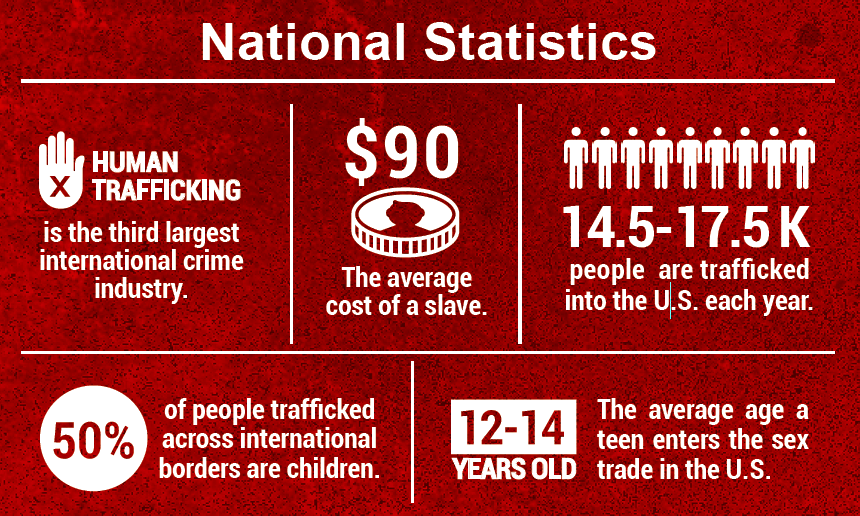
  • Based from the International Labor Organization (ILO), there is an average of 24.9 million of people who are being victims of human trafficking.
  • A victim cost is over $90
  • Most people were not aware from this kind of danger due to low socioeconomic status, countries and region.
  • Human trafficking can involved to Labor Trafficking or Sex Trafficking
Human rights most affected by trafficking
• The prohibition of discrimination based on race, color, religion, national or social origin
• The right to life
• The right to freedom and security
• The right not to be subjected to slavery or forced labor 
• The right not to be subjected to torture and / or cruel, inhuman treatment or punishment
• The right not to suffer gender violence
• The right to freedom of movement
• The right of the child to special protection

Image result for trata de personasImage result for human trafficking

United States and in California, Los Angeles 
  • According to U.S Department over 600,000 people are trafficked across international borders every year and people are being victims by the age 18 and over
  • This has estimated that females are at higher risk than male 
  • San Francisco and San Diego has the highest rate of child sex trafficking with high numbers of childhood
  • The average age for these exploitation for young girls is 12 to 14 years old and for boys approximately by the age 11 to 13 years old.
  • This can cause a problem to victims with diseases or infection or become suicide.
Image result for human trafficking


How does this affect me?
Human trafficking not only affects the person to whom the damage is done, but is also the people around them such like family, friends or locality. They live with fear and horrible things can happen, including death; besides that they fear that another member from a family, friendships or locality comes to pass the same thing or something similar with what the person has gone through. The family, and especially the parents are left with the hope of knowing a minimum of them, even if they are destroyed, they are still struggling to find their son/daughter.

What are your thoughts/opinions towards human trafficking?

Karen Silvia
Human trafficking is the human trade for sexual activities and exploitation which is an inhumane act. I know it happens around the world mostly in the third world countries because sometimes the security or law enforcement is corrupted and responsible. And from what I know it is mostly children and women. In the US, I think it is less occurring but there are stories and documentaries on YouTube about it.
Ariana Covarrubias
Well my views on human trafficking is that it is absolutely inmoral and unhuman and that no individual should have to do something they don't desire to do. I view human trafficking as an issue that society has and unfortunately will continue to have until the laws and rights are strictly enforced.
Yanet Gambao
Human Trafficking is the trade of humans for exploitation. It is problem that has got to stop. Innocent people get captured and are sent somewhere else to get exploited. It is sad to see many children involved in this type of situation. Many of the times they get children because it is easier to traffic drug through them. I think its situation ongoing problem but many people don't know about it or after searching for someone missing for so long they just forget.
Berenice Aragon Human trafficking is a world war issues. The concept can be seen as slavery because women and men can be put into labor as an obligation. The person who has them in captivation is seen as the person in charge of them, one way or another. The person uses hard measures on the person or people in a way to have power over them. Human trafficking takes away the rights of the person or the people who are to be part of human trafficking. Majorly of the labor they are force to do is doing sexual activities but the income the person who is force to do does not get part of the money or some of it, but the majority of it goes to the person who forces the labor on the person.


Reference

Brinlee, M. (2018, August 24). 13 Sex Trafficking Statistics That Put The Worldwide Problem Into Perspective. Retrieved from https://www.bustle.com/p/13-sex-trafficking-statistics-that-put-the-worldwide-problem-into-perspective-9930150

11 Facts About Human Trafficking | dosomething.org | Volunteer for Social Change. (n.d.). Retrieved from https://www.dosomething.org/us/facts/11-facts-about-human-trafficking


Sunday, April 7, 2019

Mental health

Mental Health and friendships

I see mental health as a common issue at my school. I feel a lot of people, including myself, are going through a tough transition in school. Some of us are away from our families for the first time. Others are struggling with the beginnings of adulthood. Some struggle with personal issues outside of our academic lives. It's also difficult when we have to tackle these issues alone.

"Youth is a life period where individuals experience multiple stressors due to their developmental stage, adjustment to new college environment, academic expectations, and their specific higher education program of study" (Othman, 2019). Other stressful factors may include their personal, interpersonal, family, social-economic and political factors (Othman, 2019).

Studies show that students who have previous help in counseling are more likely to seek support, and use less avoidant coping strategies. (Niegocki, 2019) Research also shows that students without previous counseling experience seek help in other ways such as emotional support from friends, and family. (Niegocki, 2019)

Friends are beneficial to our mental health, and close friendships are hard to make considering our school lacks that sense of community and belonging. I've reached out to some friends from school and spoke about mental health.


This is my friend Mario. His college experience at Cal State LA was a bit lonely at first since he was away from his friends and family for the first time. He is new to the city of LA, and comes all the way from San Diego. He eventually found a great sense of belonging at this school when he found out about the Korean club and joined. From there his experience in college improved and he felt much happier and outgoing.


This is my friend Damian. He is also from San Diego and lives in the dorms. He really did not have much friends, and was new to the area. He was fortunate to have a roommate who was a photographer and together decided to do photo shoots together. From that point on, he started to feel less homesick and felt good about his decision to live in the school dorms.

References:

Niegocki, K. L., & Ægisdóttir, S. (2019). College Students’ Coping and Psychological Help-Seeking Attitudes and Intentions. Journal of Mental Health Counseling41(2), 144–157.

Othman, N., Ahmad, F., El Morr, C., & Ritvo, P. (2019). Perceived impact of contextual determinants on depression, anxiety and stress: a survey with university students. International Journal of Mental Health Systems13(1), N.PAG.

Thursday, April 4, 2019

Racism by Phillip Rodriguez

Racism 

by Phillip Rodriguez

     Traditional racism has been prominent in American and others culture for centuries with examples of slavery but it is believed that racism is diminishing in the modern age. However is it really?

Scientist have discovered a new form of racism, or one that isn't entirely gone. It's called subtle Racism. According to the American Journal of Political Science under the article,  "The New Racism", "...many fear racism itself has not disappeared; it has only been replaced by a new racism, 'more indirect, more subtle, more procedural, more ostensibly nonracial'." Racism is still present within the communities even for other professional scientists. Two Latino professors and scientists, Alfredo Quiñones-Hinojosa (professor, neurosurgeon at Johns Hopkins University, and Chair of Neurologic Surgery at the Mayo Clinic in Florida) and Daniel A. Colón Ramos (professor and researcher of neuroscience and cell biology) tell their story about experiencing racism in the workplace. In the article "Racism in the Research Lab" published by the New York Times, they state regardless of their heroism of saving a life and finding new scientific discoveries, they will always be stereotyped as "'illegals', 'anchor babies', and 'rapists.' or if recognized for their accomplishments they receive comments such as "'You are too smart to be Mexican' and 'Congratulations! You probably got the award because you are Latino'". They go on to say, "Being a minority in this country means inheriting a narrative of prejudice, regardless of personal accomplishments...We all need to acknowledge racism and its heavy-handed presence in our communities." Because of this type of casual racism, Lu-in Wang, author of Discrimination by Default: How Racism Becomes Routine, draws on social psychology and believes these racist remarks are unconscious where "discrimination occurs by default and not design". She also demonstrates how they play out in a range of everyday settings and suggests ways for institutions and individuals to recognize and end it. Also, according to Matthew Clair (professor at Harvard University) and Jeffrey S Denis (professor at McMaster University) in Racism, Sociology Of,  they state, "In the post-Civil Rights era, with (overt) racism now widely condemned, one challenge for social scientists is to conceptualize and measure its more subtle and diffuse manifestations and lasting effects." Racism is still effective throughout communities from unconscious thinking whether it is subtle or not. With the help of each other and scientist we can create a world that is not so stereotyped.


My Story

     I chose this because it not only surrounds me everyday in my community but I have been a victim of it myself. Talks and issues of racism have been blown up in media but it also very much exists on a smaller scale anywhere you look even right next to you. Family members, friends, and even people who I am not close to would say racist remarks without knowing it, just what Wang referred to. From the news and passing through prominent Asian residential or business streets they strike a conversation between my family members about how "Asians are greedy and want to steal American business' to take over the world". Even some of my Hispanic friends who have been victims of racism would also say racist remarks out of humor such as "only a white person would buy that" pointing to a ridiculously oversized floppy straw hat and then laughing it off as a joke. Not only have friends been racist but strangers have, even towards me. It may not be in the most negative connotation as other racist remarks have been but all my life many assume I speak Spanish and either start speaking it in front of me or ask if I do because I am Latino however that is not the case. I wasn't raised in a Spanish-speaking household so when I have to tell them I do not  know much of it, they get very confused and once I was reprimanded for it. After telling my friend's grandmother that I could not understand her since she was speaking Spanish to me, she face palmed herself and shook her head, sighing then speaking in broken English, "Aye, really? Mijo, you should speak it. You must learn it or else you won't know what people saying. It's a shame you don't know multiple languages." Just like me, others of my community have been victims of racism.

The Community Affected


"When I was little I tried to play with the neighbor girl who was my age and white. She didn't want to play with my younger sister or I because we had darker skin color. She just wanted to hang out with my older sister who was lighter skinned."

-Samantha Rendon


"I was at work in drive through and I had someone tell me I was a worthless Hispanic for not knowing Spanish and have been told "Is there a white manager I can talk to?"


-Lexzene Giron

Justin Sepulveda


References

Sniderman, Paul M., et al. “The New Racism.” American Journal of Political Science, vol. 35, no. 2, May 1991, p. 423., doi:10.2307/2111369.

Colón Ramos, Daniel A., and Alfredo Quiñones-Hinojosa. “Racism in the Research Lab.” The New York Times, 4 Aug. 2016, kristof.blogs.nytimes.com/2016/08/04/racism-in-the-research-lab/.

Wang, Lu-in. Discrimination by Default: How Racism Becomes Routine. New York University Press, 2006.

Clair, Mathew, and Jeffrey S Denis. “Racism, Sociology Of.” International Encyclopedia of the Social & Behavioral Sciences, 2nd ed., vol. 19, Elsevier Ltd. , 2015, p. 857.


Monday, April 1, 2019

Reflecting on Food Waste


 “Food loss represents the amount of
food post-harvest, that is available
for human consumption but is not
consumed for any reason. It includes
cooking loss and natural shrinkage
(for example, moisture loss); loss
from mould, pests, or inadequate climate
control; and food waste.
Food waste is a component of food
loss and occurs when an edible item
goes unconsumed, as in food discarded
by retailers due to color or
appearance, and plate waste by consumers”
(Buzby, Farah-Wells, and
Hyman, 2014 ).


Hi, I'm Erin. 

Stopping Food Waste

When it comes to food insecurity in the United States, there is no lack of food, just major problems with distribution. There are tons of food going to waste that hungry people need. It goes to landfills and all that energy, in the form of sunlight, nutritional potential, water, meat, labor, land, time and money, is wasted. 

Before going back to school to study food science, I used to be a personal chef. I have made a lot of food for clients that ended up as leftovers and that extra food (or ingredients), oftentimes, was wasted. I will honestly say that the only New Years resolution I have come close to keeping was 2018’s hope to waste less food. It helped that I quit my side hustle as a personal chef but I find myself having to stay vigilant.

While it's easy to laugh it off when throwing away that bag watery spring mix that died in your produce drawer, it's actually a really serious issue. That food now is contributing not only organic material to the landfill, but also the packaging it came in (probably plastic) and it would have been so appreciated by someone living without access to fresh vegetables. This is not a guilt trip about cleaning your plate. It's about using your money and time wisely and respecting the food you choose to put into your body. This is about respecting your community by not contributing more than your fair share to landfills.

Food waste is everyones problem. Do your part, buy only what you need and use it. There are countless others who would call themselves lucky to have the opportunity to use that perfectly good food. Programs like the LA Food Bank work tirelessly to provide to hungry members in our community and they work daily to keep good food out of landfills.


Thursday, March 28, 2019

Gentrification


Gentrification


When people think of gentrification they think of it simply as neighborhood revitalization or making improvements to houses. However, gentrification is much more complicated. According to Sutton, the term “gentrification” really refers to "the processes by which people of higher income or status relocate to or invest in low-income urban neighborhoods”. Higher income people come to these uninvested neighborhoods to capitalize on the low property values. However, this inflates property value, displaces low-income residents, and completely alter the cultures and way of life of the neighborhoods.

Difference Between Revitalization and Gentrification?

Revitalization can take two forms: incumbent upgrading and gentrification. 
  • Incumbent upgrading is when residents of the neighborhoods improve the condition of their neighborhoods. This improves housing, attracts businesses and makes the neighborhood safe and clean. When incumbent upgrading occurs, the neighborhood still remains affordable for low-income people. 
  • Gentrification, on the other hand, draws middle or upper-class residents to the city. They are attracted by job and opportunities, low housing prices, stabilization of negative social conditions such as crime, and perhaps the desire to a new lifestyle. 
The adverse result of gentrification is displacement, however, displacement is not present in incumbent upgrading. 

Now, what are the Causes of Gentrification?


According to Vo, gentrification occurs when there is a lot of public transportation available for people to use. Transits such as train, bus, and etc. provide an alternative to car thereby reducing transportation cost costs for residents. Another cause of gentrification is schools and education. The quality of schools and universities is a key determinant for the property value. Popular schools can accelerate the gentrification process by bringing money into neighborhoods by providing housing and other resources for students, faculty, and staff. Take for example, during 2018, the University of Southern California, one of the most prestigious universities in the west, spend over 700 million dollars building the USC Village. The completion of USC Village transformed the surrounding neighborhoods with new buildings such as dorms to house over 2,500 students as well as a Trader Joe’s, Target, Starbucks and over 20 other well-known businesses.


USC is located less than five miles from Los Angeles, one of the most gentrified areas in the U.S.

According to Carter, from 2000 to 2016, Los Angeles has seen:

  • An increase in property values by 707 percent
  • An increase in median household income by 95 percent
  • An increase in people holding a bachelor or higher degrees by 857 percent

The Result of Gentrification?

The most adverse effect of gentrification is displacement.

According to a recent comprehensive review of gentrification completed by researchers at UC Berkeley and UCLA, displacement occurs “ when occurs when any household is forced to move from its residence by conditions which affect the dwelling or immediate surroundings, and which:
  • are beyond the household’s reasonable ability to control or prevent
  • occur despite the household’s having met all previously-imposed conditions of occupancy; and
  • make continued occupancy by that household impossible, hazardous or unaffordable.”
The most common form of displacement is direct displacement. Take for example you’ve been living in a neighborhood for 4 years and paying 1,200 dollars a month but all of a sudden your landlord increases your rent to 2,400 dollars. When faced with this dramatic increase in rent most people would have no choice but to leave. That is direct displacement.

Why is Gentrification Relevant to me?


I choose this issue because I want to spread awareness of gentrification and help people understand what gentrification actually is. Surprisingly, not a lot of people are aware of what the word gentrification actually means. I also wanted to take this opportunity to inform myself about gentrification such as the causes and the effects. This issue has affected thousands of families not just in Los Angeles but all across other cities as well. Rent is constantly rising year after year and it has affected many people I know. I have seen it affect my uncle’s family who had to move away from Los Angeles because they could not keep up with the rising rent. Even in my city of El Monte, I have seen signs of gentrification occurring with the influx of Chinese population in a city predominantly Hispanic. I hope that everyone will have a better understanding of gentrification after reading this blog.


Community Opinions


"Although I never experienced gentrification first hand, I know it's making it difficult for people who live in the area to stay there as the cost of housing goes up. It is definitely an issue that cities need to resolve"
- Kevin G.


“I've been aware of gentrification and have known people who had to leave the state for another because of the cost of living. I also knew people who had to share a house/apartment because of the inflation on house/rent prices. I believe that there's not much a person can do about it and to just go with the flow.”
- Ricard L.


Works Cited

Carter, Shawn M. “This LA Neighborhood Is the Most Gentrified in the US.” CNBC, CNBC, 6
Mar. 2018,
www.cnbc.com/2018/03/06/la-and-the-other-top-10-most-gentrified-zip-codes-in-the-us
html.

Sutton, Stacey. “3 Common Myths About Gentrification – And the Facts That Prove We Need to
Stop It.” Everyday Feminism, 2 Oct. 2015,
everydayfeminism.com/2015/10/truth-about-gentrification/.

Vo, Kelly. “University Neighborhood Gentrification Statistics.” MetroMBA, MetroMBA, 14
Aug. 2018, www.metromba.com/2018/08/university-gentrification-statistics/.

Zuk, Miriam, et al. “Gentrification, Displacement and the Role of Public Investment: A
Literature Review.” Community Development Investment Center , University of
California, Berkeley, University of California, Los Angeles, Aug. 2015, www.frbsf.org/community-development/files/wp2015-05.pdf.

Monday, March 11, 2019

Vaccinate Yo Kids!

 What are Vaccines?


 Vaccines are combinations of biological substances used to stimulate the production of antibodies and provides protection against several diseases. The first vaccines were created in the early 18th century by Edward Jenner. Jenner was able to create a successful vaccination that fought against smallpox. Jenner was able to do this by taking bacteria from a blister that an infected individual with cowpox had and inoculating it into another person's skin. There are so much negatives narratives regarding vaccines, and unfortunately, most people listen to the bad more than the good narratives. According to Bruine de Bruin, author of  Effects of Anti- Versus Pro-Vaccine Narratives on Responses by Recipients Varying in Numeracy claimed: "It has been proposed that anti-treatment narratives will be more influential on decision making than pro-treatment narratives because they can seem relatively more informative.) 


How have vaccines helped society?

Three reasons on how it's improved our society's overall health according to vaccines.org


1)  Vaccines have been proven to actually work and most importantly it's safe- When vaccines are given to children young, they're able to develop what they need to fight diseases. The overall process of vaccines may cause some discomfort when injecting the substance into your skin but the pain is minimal. It's really rare when one has an allergic reaction to a vaccine. Eun Hee Chung who's focused her research on primarily vaccines allergies stated that "Vaccines, specifically individual components of the vaccine, are known to, although rarely, cause serious complications.


2) Immunizations promote a healthy life for children-  Fortunately, children's health can be protected more. There are many diseases that have been proved to be deadly to children. One example is Polio. Vaccines were the only medical procedure that was successful in preventing polio among children. Fortunately, because of vaccinations, there are no reports of polio in the United States. 


3) Vaccinations protect others-  Diseases like whooping cough and measles have decreased due to people getting vaccinations. When a majority of the population is vaccinated, it keeps certain diseases under control. However, there are certain people who cannot get vaccinated because of weak immune systems, or they might be allergic, other people who are vaccinated can help prevent diseases being accessible to those who can't get vaccinated. By being fully vaccinated, you're able to protect your loved ones and others.

Data Proves that Vaccines are important for our health 


i

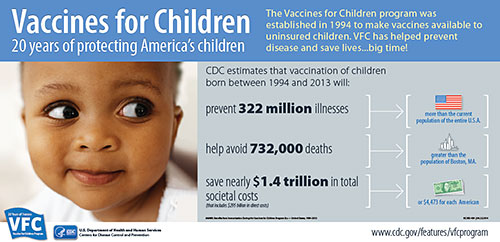
The chart displays research done one year's olds overtime.  Vaccinations on babies have increased dramatically, however for a very long time, we've been stuck at the 70-80 percent mark. In order to have diseases under control, we must increase vaccinations among the population to at least 90%.

What does my community have to say about Vaccines?

(Sarahi Salcedo, BA in Child and Adolescent Students) 

Sarahi Salcedo strongly believes that everyone should get vaccinated. She states, "We're exposed to a lot of new bacteria and diseases every day, being vaccinated may prevent us from being affected or Spreading it to other people." She thinks that the reason why the death toll number of people dying of diseases were so high. People in the past died due to diseases being spread to one another. 

(Luis Gonzalez, B.A. in Liberal Studies) 
Luis Gonzalez believes that all parents should vaccinate their children in order to promote a disease-free future for them. Children are at high risk of getting diseases, and unfortunately, a lot of these diseases are potentially deadly. He continues to say that during childhood, a child's body is always developing and diseases can disrupt the developmental process; A child's body won't reach full development until after they become adults.

(Michelle Casarez, B.A. in Environmental Systems)
Michelle Casarez claims that there are a lot of celebrities who are promoting people not to vaccinate their children and they're sending the wrong message. One known celebrity to be anti-vaccine is famous tattoo artist and make-up guru, Kat Von D. Michelle believes that Kat Von D should not be using her platform of over a million followers to be promoting anti-vaccine rants. 
(Mike Reyes, Sophomore at Leuzinger High School)

If children dont get vaccinated, they're putting people who have weaker immune systems at risk. Some peoples body's cant handle vaccinations and are more susceptible to becoming sick, so those who can should feel privileged and take care of themselves and others by getting vaccinated. By not getting vaccinated, people are just bringing rise again to diseases that could've been prevented altogether

Why is this issue important to me and my community?

Image result for toddlers and vaccines'
I made my decision to vaccinate my child because I felt it would be the best option to protect him from deadly diseases. Unfortunately, his immune system is not the strongest. He's often getting sick easily compared to other children. In order to protect him and others, vaccinations help keep all the deadly bacteria away from reaching.

Citations

Bruine de Bruin, W., Wallin, A., Parker, A. M., Strough, J., & Hanmer, J. (2017). Effects of Anti-       Versus Pro-Vaccine Narratives on Responses by Recipients Varying in Numeracy: A Cross-sectional
Survey-Based Experiment. Medical Decision Making, 37(8), 860–870. https://doi.org/10.1177/0272989X17704858

Five Important Reasons to Vaccinate Your Child. (n.d.). Retrieved from https://www.vaccines.gov/getting/for_parents/five_reasons