Welcome to the ART 3170 blog created as part of the civic engagement requirement of this course. In this blog, students will identify a major social issue that affects them and their communities. After conducting brief research on the issue and sharing their personal feelings, students will locate members of their communities who are also affected by the same social issue.
Tuesday, October 27, 2020
The Causes & Growing Problem of Traffic in LA
From a Gen Z Perspective: Depression and the Future
Anthony Tran, 27 October 2020
In the United States, Generation Z aka. “The Zoomers” is the generation of technology, and compared to every other generation, “has an easier and better life” than everyone else which is why we see a rise in depression and suicide becoming the second leading cause of death for the privileged generation. The reality of it all is you may not know that your child, or your peers (If you’re generation Z also) are suffering silently or maybe under immense stress that although you overlook, can be the last time you may see that individual. Generation Z although having knowledge and technology at their fingertips, does not mean that they are having it easier than every other generation.
Generation Z Origin Story:
Generation Z knows as the Zoomers were born from 1996-2015 and there is big talk about how this generation is more connected to the internet which has opened Pandora's box ranging from cyberbullying to memes that hide the painful cries of a generation, but in reality, we don’t acknowledge that this generation has gone through the most life events than any other generation in the span of 27 years. The Zoomers were blessed with the first smartphone but were stricken with 9/11 leading to a war in the Middle East instilling fear in the generation. Although there was war foreignly, the generation had its first taste of war via the rise of school shootings leading to the constant fear of not making home to their family. It’s an issue where you as a child expect to go to school every day and learn with a constant fear of a trigger being pulled. Another milestone was the election of the first Black President who was elected twice which instilled change but also left a civil division from then on which is still prevalent today with our current president Donald Trump. The Zoomers had its big technological boom but was hit with a recession, and watched millennials not being able to afford a place to live, not being able to get a job due to the choice of degree, seeing that college is becoming more expensive from the effects of the recession; the Generation learned to be wiser with money. Climate change has made it harder for Generation Z to enjoy the weather and has polluted the earth due to the decisions of previous generations which instilled the duty of trying to fix and undo what has been done, but there is hope with the rise of electric cars thanks to Tesla. In the current year of 2020, Generation Z has experienced a fear of going to war(US-Iran Conflict), a major wildfire(Australian WildFire), Racial Injustice(George Floyd), a major pandemic (COVID-19), and a loved social media platform almost being banned for connection with China(TikTok) amidst a presidential election on the horizon. When looking at the factors that may have influenced the Zoomers we might as well name them the Gloomers because of how much they have gone through in such a short amount of time, and not add on the events that might be affecting the Zoomers personally such as family or other stressors. These events shape the world that we live in, and our Zoomers are taking the brute force of it all because they don’t have a say in these events and have to live through them which shapes their mentality and can lead to depression and suicide rates we’re seeing.
Generation Zoomers Gloomers or actually Realistic
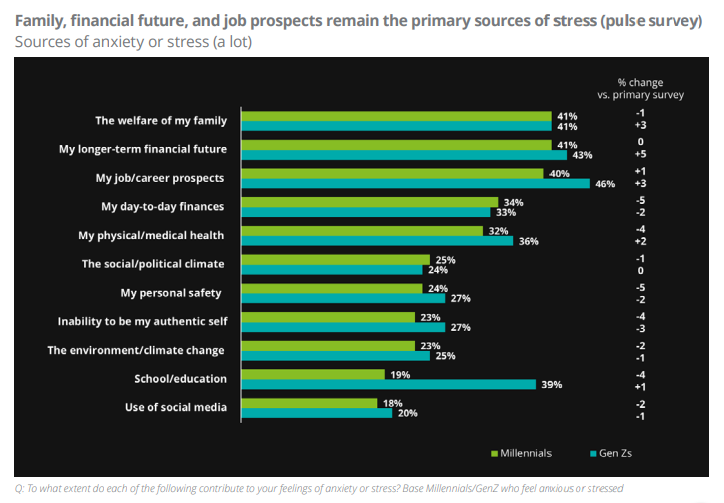
With Zoomers being hit with multiple stressors, researchers have tried to pinpoint what is the biggest stressor on Generation Z which came with multiple answers, but all related to the prospect of life stability. Research on Millennials and Generation Z around the world, by the Deloitte research group in 2020, showed the world the outlooks on the future and key ideals of both generations; one of the sections studied was stress which is shown in Table 1. There were a total of 8,300 Zoomers surveyed from around the world on their thoughts which shows that the main stressor may originate from school and social media. From the table, we can see that school is a big stressor for many Zoomers, and this might be the expectations put upon them to succeed or gain financial stability, and the recession that had happened in 2008. (Deloitte p.2)
Table 1: Stressors of Gen Z and Millennials (Deloitte 2020) |
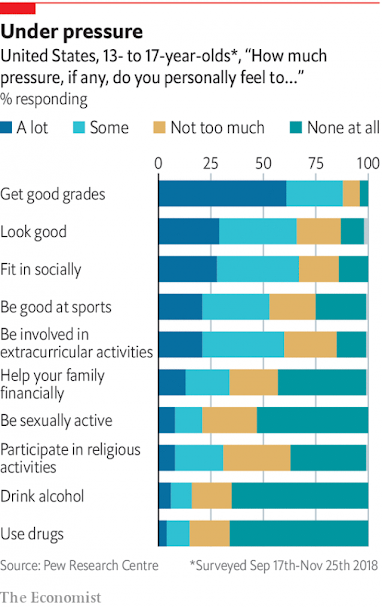
In another study by the Pew Research Centre in 2018 showed that Generation Z teens weren’t pressured to do drugs, drink, or sex, but in reality was pressured to be a well-rounded individual and get good grades in school being the main pressure among teens.(Table 2.) The constant fear of failing, or not fitting in may stem from previous topics such as the rise of the internet which has led to social media, and with an awareness of the surroundings, getting good grades might be a way to achieve financial stability.
| Table 2: What is pressuring teens? |
Social Media
I want you to check your phone, Instagram, Snapchat, Facebook, TikTok, Twitter; I can assure you that you or your child might have one of these apps. Social Media has connected our society and has become a way to portray our perfect life, and a way to keep tabs on other people creating a perpetuating cycle of expectations. The American Psychological Association had conducted a survey in 2018 on Generation Z, and one of the highlights was the impact of social media and the thoughts of social media from the generation. The researchers noted that “Despite high percentages of Gen Zs feeling stress from different causes, only half (50 percent) feel they do enough to manage their stress; one in four Gen Zs (25 percent) say they do not feel they do enough.”(APA 2018) which can show us that there are two sides of a coin when it comes to the impact of social media. Social media could be used as a way to vent, and stay connected with friends, but also can be a medium for cyberbullying and high expectations; however, it depends on how the individual uses the platform.
What’s the point of this?
As a Zoomer myself, I think that the biggest issue my generation including myself pertains to mental illness, and the amount of pressure we have to go through only to suffer silently without anyone knowing. I believe that even if your friend or a stranger is the nicest person and happiest person in the world, it may be just a front which is a method to protect themselves, or not burden you. How I know this is that I’ve done this many times, and I can assume that you’ve heard or said the lines, “I’m fine.” when you really aren’t. The point of this article is to bring awareness to the issues that my generation has to go through and give verification to my generation that it’s understandable the amount of stress, and expectations put on you, but there are ways to cope such as with self-care and opening up. In the survey by The Economist,” 70% of respondents thought anxiety and depression were a major issue among their peers” which shows that we are aware of the need to address mental illness in our generation.(Economist,2019)
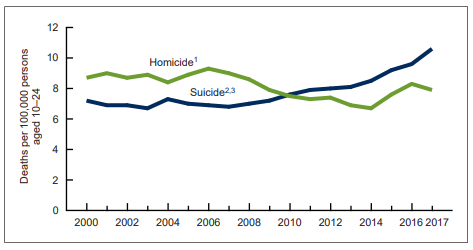
| Table 3: Suicide and homicide death rates among persons aged 10–24: United States, 2000–2017 |
What can we do?
Suicide is prevalent in our generation, and a study from the CDC from 2010-2017 showed that suicide rates have surpassed homicides and is the second killer of the generation.(Table 3) As a nursing student, we learned to not beat around the bush on the topic, and be direct about suicide because it may be possible you are wasting precious time or not getting anywhere by doing this, so even if it sounds harsh or confrontation asking, “Do you want to kill yourself?”, or anything between those lines gets the point across. This also allows an avenue to discuss with the person about what’s on their mind, and possibly save their life. (MayoClinic) I had a friend that tried to kill herself recently due to feeling lost in the world, and not knowing what to do with her life after college; had I was not direct about the question and checked up with my friend who knows what could have happened.
I think that checking up on your friends and getting “deep” with them helps relieve pressure and expectations from the world because it allows both of you to vent your frustrations or worries about life. For males, it’s okay to let down your bravado and discuss with your “bros” about what’s on your mind because we’re human not superheroes who can keep everything to ourselves. Speaking up about your problems to someone, venting it out through art, writing in a journal, or any other possible way to let out your emotions is good self-care.
Social media as mentioned, is a double-edged sword, and how we approach it will dictate how we’ll feel. Sometimes personally, when social media is too much, I just deactivate or take a social media to cleanse for a few weeks, so I can recoup my mental health, and get away from expectations to work on myself, but some may need to use social media as their work to which I respond, use it in moderation.
Finally, knowing and sharing the available resources in our communities can aid our generation to be better off, and ease the pressure put onto us. An important resource that anyone with a phone has access to is the Suicide Hotline which provides a judgment-free zone, and professional help for friends and individuals who have suicidal ideation. If you are feeling lost about your situation and need help, you can also call the National HelpLine which will refer you to the proper help pertaining to mental and substance abuse disorders. Both of these lines are also toll-free. If you go to Cal State LA, there is professional help such as a therapist that is free because it is included in your tuition.
Resources
SAMHSA(National Help Line):1-800-662-HELP (4357)
National Suicide Hotline: 1-800-273-8255 (Online Web Chat Available)
Cal State LA CAPS: 323-343-3300
Common Ground: 1-800-231-1127 (Also has Web Chat/Text)
Mental Health: A College Student's Battle
Mental Health:
A College Student's Battle
What is Mental Health?
Signs that you may be Affected:
- Eating or sleeping too much or too little
- Pulling away from people and usual activities
- Having low or no energy
- Feeling numb or like nothing matters
- Having unexplained aches and pains
- Feeling helpless or hopeless
- Smoking, drinking, or using drugs more than usual
- Feeling unusually confused, forgetful, on edge, angry, upset, worried, or scared
- Yelling or fighting with family and friends
- Experiencing severe mood swings that cause problems in relationships
- Having persistent thoughts and memories you can't get out of your head
- Hearing voices or believing things that are not true
- Thinking of harming yourself or others
- Inability to perform daily tasks like taking care of your kids or getting to work or school
Works Cited
What Is Mental Health? (n.d.). Retrieved October 27, 2020, from https://www.mentalhealth.gov/basics/what-is-mental-health
Statistics. (2020, October 08). Retrieved October 27, 2020, from https://www.activeminds.org/about-mental-health/statistics/
Monday, October 26, 2020
Sydney Stanton- The Stigma Around Mental Health
The Stigma Around Mental Health
Sydney Stanton
ART 3170
Monday October 26th, 2020
What is a Social Stigma?
Patrick Corrigan and Amy Watson created a research article for others to understand the impact of stigma on individuals with mental illnesses. They discuss a social stigma as a negative stereotype, prejudice, and discrimination that includes having a negative belief about a group, agreeing with a negative belief and having an adverse emotional reaction, and behaving on that negative prejudice toward a group (Corrigan & Watson, 2002). Essentially it is a negative stereotype, prejudice, and discrimination wrapped up into one term. For example, a common mental health stigma is that if an individual puts in the effort to resolve their emotions or 'tries harder,' that individual can overcome a mental illness, which in fact is not true. Now imagine the effects of this mental health social stigma on those diagnosed with a mental illness.Statistics and Facts on Mental Health
19.1% of U.S. adults experienced mental illness in 2018 (47.6 million people). This represents 1 in 5 U.S. adults ("Mental Health By the Numbers," 2019).
The demographic of 'non-Hispanic mixed/ multiracial' has the highest prevalence (26.8%) of mental illness among United States adults ("Mental Health By the Numbers," 2019).
There is a high prevalence of mental illness (34.7%) in individuals of the LBGTQIA+ community ("Mental Health By the Numbers," 2019).
Mental illnesses vary on a spectrum and range from mild to moderate to severe ("Mental Health Information: Statistics," 2019).
19.1% of U.S. adults experienced mental illness in 2018 (47.6 million people). This represents 1 in 5 U.S. adults ("Mental Health By the Numbers," 2019).
The demographic of 'non-Hispanic mixed/ multiracial' has the highest prevalence (26.8%) of mental illness among United States adults ("Mental Health By the Numbers," 2019).
There is a high prevalence of mental illness (34.7%) in individuals of the LBGTQIA+ community ("Mental Health By the Numbers," 2019).
Mental illnesses vary on a spectrum and range from mild to moderate to severe ("Mental Health Information: Statistics," 2019).
- The chart shown above is from Aware, and it discusses the level of comfort individuals have about talking about mental health ("The Stigma of Mental Illness," 2020).
The Stigma of Mental Health: How it Effects Others and My Community
The social issue of the stigma around mental health in the United States has always been negative and harmful for all individuals dealing with mental illness. Discussing mental health with others, besides physicians, has always been a tense topic. Explaining emotions and your mental state to others, at least in my opinion, is challenging, uncomfortable, and awkward, and I am sure numerous others feel the same way. This is because not many individuals discuss their emotional well-being with others, so it is seen as shocking when someone does. It has been a long-standing social idea to avoid talking about mental well-being for many reasons, but some include: it shows weakness, ruins the idea that an individual is perfect or is fine, and an individual dealing with mental illness does not want to be judged by their peers; this shows why the stigma of mental illness makes individuals bottle up their thoughts. I know that these reasons may seem like highly conservative ideals, but I feel that the way we go about talking about mental health has not changed much until this generation.
The stigma of mental health has affected my community, and I know that these same instances in my community have happened in others'. While I was in high school, there were three suicides; two of them were from drug overdoses, which happen in many suicide cases as substance abuse is often linked to mental illness ("Mental Health By the Numbers," 2019). These individuals rarely spoke to anyone about their emotional state; it was only until after they passed, the community learned they all had an underlying mental illness. The stigma surrounding mental health most likely caused them not to speak up about what was going on in their head. These three individuals were also men, and combining toxic masculinity created by society with the stigma surrounding mental health, speaking up about their mental illness would make them seem weak, which is the last thing a boy wants to be thought of as. In World Psychiatry, Patrick Corrigan and Amy Watson say, "One might think that people with psychiatric disability, living in a society that widely endorses stigmatizing ideas, will internalize these ideas and believe that they are less valued because of their psychiatric disorder" (Corrigan & Watson, 2002). This statement made me think about how many other individuals with mental illnesses are affected by this awful stigma and feel this way, and if the three individuals stated previously thought this way.
The ways that media portray mental health and illness greatly affect the public's view and understanding of mental illness and worsen the stigma. For example, in a study by Corrigan and Watson, they stated, "Media analyses of film and print have identified three [themes]: people with mental illness are homicidal maniacs who need to be feared; they have childlike perceptions of the world that should be marveled; or they are responsible for their illness because they have weak character" (Corrigan & Watson, 2002). I believe that misinformed individuals think this way about people with mental illness because I have witnessed one of these themes first hand. At the end of my street lives a man with what I believe has schizophrenia. He walks daily past my house, and when I happen to see him, I usually wave because he is super sweet and harmless. One day I was driving with my sister and her friends when one of them stated that he looks like a psychopath, thank goodness my sister isn't friends with that girl anymore. However, this shows how the media affects others and their understanding of mental illnesses. The media portrays mental illness as something you need to stay away from because they show individuals with mental illness as unpredictable and threatening when, in reality, there is a minimal chance someone with mental illness would harm anyone. In fact, individuals with mental illness are more likely to be victimized by violent crime than be the perpetrator of violent crime ("Risk Factors for Violence in Serious Mental Illness," 2016). This goes to show that not everyone with a mental illness is secretly Hannibal Lector.
Due to the stigma around mental illness, not many individuals talk about it with others. This then leads to a lack of education and knowledge about mental illness. Being uneducated about mental illness can significantly affect society because these uneducated individuals won't know how to address the serious topic when the conversation comes up or know the signs of mental illness in another person, family member, or close friend. A study from Corrigan and Watson states, "Unlike physical disabilities, persons with mental illness are perceived by the public to be in control of their disabilities and responsible for causing them. Furthermore, research respondents are less likely to pity persons with mental illness, instead reacting to psychiatric disability with anger and believing that help is not deserved" (Corrigan & Watson, 2002). Combining the lack of education on mental illness with the ways others in society react to individuals with mental illness can cause someone's mental illness to worsen.
How the Stigma of Mental Health is Effects Me
What we can do to eliminate the stigma
Conclusion
Mental Health Resources
- SAMHSA’s (Substance Abuse and Mental Health Services Administration) National Helpline : 1-800-662-HELP (4357)
- National Suicide Prevention Hotline: 1-800-273-8255
- Crisis Hotline: 1-800-273-TALK (8255)
- Or text 'MHA' to 741741
Corrigan, Patrick W, and Amy C Watson. “Understanding the Impact of Stigma on People with Mental Illness.” World Psychiatry : Official Journal of the World Psychiatric Association (WPA), Masson Italy, Feb. 2002, www.ncbi.nlm.nih.gov/pmc/articles/PMC1489832/.
N/A. “Mental Health By the Numbers.” NAMI, NAMI, Sept. 2019, www.nami.org/mhstats.
N/A. “Mental Illness.” National Institute of Mental Health, U.S. Department of Health and Human Services, Feb. 2019, www.nimh.nih.gov/health/statistics/mental-illness.shtml.
N/A. “Risk Factors for Violence in Serious Mental Illness.” Treatment Advocacy Center, Treatment Advocacy Center, June 2016, www.treatmentadvocacycenter.org/evidence-and-research/learn-more-about/3633-risk-factors-for-violence-in-serious-mental-illness.
N/A. “The State of Mental Health in America.” Mental Health America, Mental Health America, 2020, www.mhanational.org/issues/state-mental-health-america.
N/A. “The Stigma of Mental Illness.” Aware, Mentalhealth.net, 2020, www.mentalhelp.net/aware/the-stigma-of-mental-illness/.
Alma Pineda- Drug Abuse
Drug Abuse in the Community
Quote: "Drugs are the enemies of ambition and hope - and when we fight against drugs we are fighting for the future."
- Bob Riley
- What is Drug Abuse?
- What are the symptoms of Drug Abuse?
- Cognitive Symptoms:
- Classification and Type of drugs:
Addiction vs Abuse:
"Addiction is characterized by drug seeking and use that is compulsive, or difficult to control, despite harmful consequences."
"Abuse is characterized by the use of illegal and legal substances in ways you shouldn't."
The Effects of Drug Addiction:
-Damaged immune system, which increase susceptibility to infection
-Seizures and strokes
-Nausea, vomiting, and abdominal pain
-Cardiovascular conditions, including heart attacks and collapsed veins
- Widespread brain damage that can interfere with memory, attention, and decision-making, brain damage
-Suicidal ideation
-Financial problems
-Depression
Effects in the Community Recent/Prior:
There has been a rise in drug use among High School students and adults. It is seen how more and more teens have been introduced to drugs. There have also been drug-related arrests as well as an increase in homelessness. People have lost their employment/jobs, which leads to their economic status going down. Not only does their economic status go down but also their relationship. As seen time and time again accidents have also occurred. The worst effect would be the behavior of the person who becomes more aggressive, distant, or controlling. Drug abuse has also caused people to be incarcerated either for selling the product or being caught using the substance. It has been affecting LA and also the US in today's time and years prior.
The Fentanyl Crisis in LA County (2019): The I-team found that it's not only dangerous but contributes to a frightening spike in deaths in LA County. DEA says that fentanyl is being combined with other drugs and abused because of how potent it is. In February several police officers from the bay area after exposure of fentanyl and the Drug Enforcement Administration made video for police to play at role call. It was stated that from 2015-2018 fentanyl deaths cause went from 13 to 225, a 1,631% jump.
Personal Story of 30 year old Nicole:
Local rehabilitation counselor went searching for Nicole and found her in bad a bad condition. She had been mixing fentanyl with other stuff. She had said that her downward spiral was due to her addiction to drugs. Nicole shared that she started taking prescribed pain pills after high school when she developed a bad case meningitis. When the pills had stopped the heroin started and then fentanyl. She had several needles in her car and purse. Her counselor then saw her struggles and decided to help her. Nicole stated that see has seen fentanyl more and more in California in the past year. Now she is fighting to stay clean so she can take care of her son.
Charts Recent/Prior yrs:
The Causes and Effects of Drug Addiction. (n.d.). Retrieved October 2020, from https://www.altamirarecovery.com/drug-addiction/causes-effects-drug-addiction/
Drug addiction (substance use disorder). (2017, October 26). Retrieved October 2020, from https://www.mayoclinic.org/diseases-conditions/drug-addiction/symptoms-causes/syc-20365112
Drug Addiction Causes & Effects. (2017, September 28). Retrieved October 2020, from https://www.life-healing.com/addiction/causes-effects/
Drug Classifications. (2020, September 17). Retrieved October 2020, from https://www.addictioncenter.com/drugs/drug-classifications/
National Institute on Drug Abuse. (2020, June 25). The Science of Drug Use and Addiction: The Basics. Retrieved October 2020, from https://www.drugabuse.gov/publications/media-guide/science-drug-use-addiction-basics
“The Fentanyl Crisis in LA County | NBCLA.” Youtube, uploaded by NBCLA, 16 May 2019, www.youtube.com/watch?v=9XcJjWeXHZs&t=6s.