Wednesday, November 10, 2021

Social Media Dysmorphia- Isabel Cabral


                                            Body Dysmorphia Caused By Social Media 


             2021 Body Image Statistics: 40 Shocking Body Image Facts


                                                             What is Body Dysmorphia?

               Body Dysmorphia is a disorder that creates a sense of worry or unsatisfied feelings about how one looks physically. A very little defect is seen to be terrible by the individual when others either don't notice it or do not find it a big deal. This disorder is found in most individuals, but many will not seek help because they are too ashamed or in denial. According to an article called Prevalence of BDD, 1.7% to 2.9% of the population suffers from body dysmorphia. That is equivalent to saying 5 million to 10 million people in the US are suffering from this disorder. The disorder itself is said to be an impairment to psychosocial functioning, develops a poor quality of life, and is a factor of high suicide rates. 

                Studies have proved that body dysmorphia exists in individuals from 5 years old being the youngest and 80 years old being the oldest. I am assuming this is because at five years old individuals start to feel self-cautious or notice differences between themselves and others. Researchers found a point prevalence of 2.5% of women vs 2.2% of men, and 1.9% of women and 1.4% of men experiencing body dysmorphia. It is women who are experiencing it slightly more, but it is a pretty equivalent percentage in both men and women. They also found that individuals experience body dysmorphia more commonly than OCD, anorexia nervosa, or schizophrenia. It is shocking because those are major disorders, so body dysmorphia really made its way to be up there to the most common disorders. 


                                                          How it affects Self-Esteem?

                According to the article Body Dysmorphic Disorder, "Approximately 40% of individuals with BDD actively think about the disliked body parts for 3 to 8 hours per day, and 25% report thinking about them for more than 8 hours per day. These preoccupations are almost always difficult to resist or control, and they are intrusive and associated with significant anxiety and distress." It is so unhealthy to spend extensive hours of your day thinking of your body parts you do not like. Individuals who experience body dysmorphia tend to have a bad self-esteem. All those individuals go through is putting themselves down and feeling less than others which is not right. They always feel as if they are not good enough whether they are too thin or too thick. It is almost like they will never be satisfied but their body type because they are hoping to look as expected by society. 

              There are compulsive behaviors that are caused by those obsessive thoughts about appearance that will help reduce their anxiety, but the behaviors will for the most part be harmful. The most common behavior in a person experiencing the disorder is comparing themselves to others in a negative way. Individuals will find any little flaw and bring themselves down. It can get pretty extreme and affects individuals lives way more than people who are not familiar with the disorder may think. People miss out on life opportunities like jobs for example because they have a fear of being judged by others or "not being good enough". It becomes a life barrier because a job is essential in one's life and not being able to take a job because of the disorder may affect your life negatively.                                                


                                         Why is it That Social Media Is a Factor?

               The individuals who are constantly on social media are influenced by those they are looking at day to day. When looking at artists, influencers, or anyone on social media people gain ideas on what the ideal way of looking is which in reality doesn't exist. There is no set and stone to how an individual should look and that includes no body type, face structure, or style. Celebrities have molded an idea of how one should look, and they have truly influenced many individuals to try to be a copy and paste. The article mentioned that individuals will do excessive exercise, shopping constantly, or grooming themselves much more than needed. They are doing all this because they are being fed the idea of living a certain lifestyle to look like the people on social media look. People who experience body dysmorphia need to realize that many celebrities have gotten cosmetic surgeries to look the way they look. They also edit their photos from head to toe to resemble "perfection", which is not the case in real life. I found the photo I inserted below that says, "Don't wish to have a waist like her because she ain't having it too" referring to Kylie Jenner. It was captioned that because on the left you see a photo from her social media that is edited to make her body look super curvy, her face is practically flawless, and even the color of her outfit stands out way more. On the right she looks completely different because it is a screenshot of a video which was not edited. 

                 Individuals should realize that social media makes everything look perfect because they get to choose what to post and let the world see. They will not post themselves looking "bad" because celebrities will always be in competition with each other to look better than one another and stand out more. It is literally their job which is why individuals should not be influenced by them whatsoever. You do not need to look like they do to be beautiful, handsome, or stylish. There is no right or wrong to body types which is what needs to be known when looking at social media. Individuals often feel like they need to follow footsteps which is what causes body dysmorphia. In the past years, I think social media has caused more cases of body dysmorphia within people for the same reason. In one of the studies they did eighty percent of the people who have been experiencing body dysmorphia have blamed it on television, fashion magazines, and advertisements. They added that it was the number one factor that made them feel insecure about themselves and how they look. 
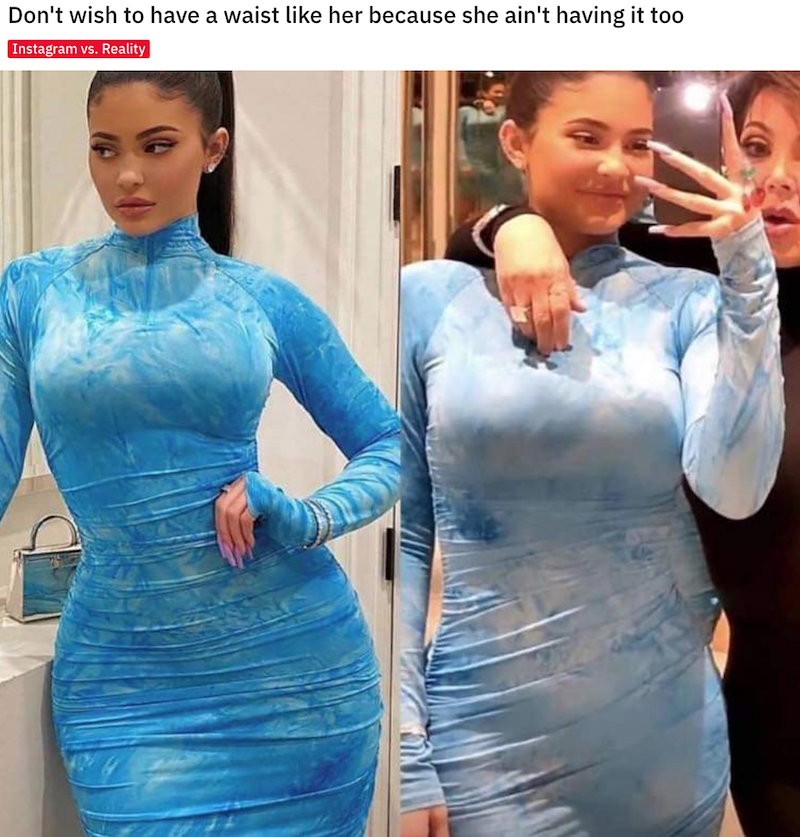

                 Instagram VS Reality (Potential Facetunes And Photoshops) - FAIL Blog -  Funny Fails    

                                                        How Can we Make a Change? 

                  Change can occur and should occur to bring more confidence to the individuals around us and lower the rates of individuals that experience body dysmorphia. All that is needed is more positivity and less judgment between ourselves to reduce those rates. Being thin is not what makes an individual beautiful and it needs to be addressed. Every commercial, movie, or advertisement always uses thin light complected models to play the role of the "pretty" or "main character" and that should change. The media needs to be more inclusive of any individual with any skin tone, height, weight, etc.. Being more inclusive in the media will make individuals feel more confident and bring reassurance to everyone no matter what they look like. 

                   First of all, in order to make a change, we must bring awareness to the disorder. There should be more insight on what body dysmorphia is and why it is caused. That way everyone around people with the disorder can be more supportive of one another and reduce the rates. Cognitive behavior therapy is recommended to help patients with body dysmorphia and has shown improvements in individuals. What is known as the "Kardashian effect" mentioned in the article called Combating 'Social Dysmorphia' should be cancelled. No one should think they need to look like that or that their body is the expectation because they bought themselves into those bodies. Natural should be seen as equally beautiful and never looked down on. As mentioned in the article individuals need to set realistic expectations, recognize that beauty is ever-evolving meaning there is always different trends, and practicing self-love.


              How Social Media Contributes to Body Dysmorphic Behavior — The Lexington  Line


                                                    How it Affects me Personally?

              This social issue affects me directly because I am an individual who is living through this new generation. This generation is full of fantasies you can say. It is sad to admit that no one can truly be themselves anymore. Not how they look, not how they act, not how they dress. Everyone kind of fell into a pattern of all wanting to look a certain way because social media says that is the perfect way a person should look or act. I stay true to myself and am natural on social media and in person, but I guess you can say I fall into the same patterns of others because they become styles. It is funny because I love the way I look but I look at social media and it makes me think I should try the looks they do or buy some clothes that the people on there are wearing. I do not experience body dysmorphia, but I see it more as fashion inspiration, I do not feel insecure about myself. I just do find myself doing things that I see online more often. 

                Not only am I affected but the people around me are too. A perfect example of this would be driving by a middle school, the little girls do not look little anymore. Social media has been influencing everyone to try to make themselves look a certain way and it is saddening. These past years I feel as if little kids did not have a childhood because they rushed to be grown. The media has really guided individuals to fit the social media expectations. They cover themselves with tons of makeup, wear baggy clothes because of insecurities, and overall try to be someone they are not.

                  I chose this issue because I don't think anyone should be a victim of body dysmorphia. Especially not if it is caused by factors like social media, other individuals' opinions, or simply the way others look. I mainly focused on body dysmorphia because many individuals focus on world disasters like poverty, addictions, and other disasters. I realized that sometimes people don't bring enough awareness to disorders like body dysmorphia because not a lot of people know what is even is. I asked around with my friends if they knew what body dysmorphia was and only some knew. I found myself explaining it to many of them and that's when I realized I was selecting a perfect topic to bring awareness on. 


                                                                    References

Bjornsson, A. S., Didie, E. R., & Phillips, K. A. (2010). Body dysmorphic disorder. Dialogues in clinical neuroscience. Retrieved November 10, 2021, from https://www.ncbi.nlm.nih.gov/pmc/articles/PMC3181960/. 

Germany, J. (n.d.). Combating 'social media dysmorphia'. Rush System. Retrieved November 10, 2021, from https://www.rush.edu/news/combating-social-media-dysmorphia. 

Prevalence of BDD. BDD. (n.d.). Retrieved November 10, 2021, from https://bdd.iocdf.org/professionals/prevalence/. 


Tuesday, November 9, 2021

Priscilla Fernandez - Abortion Rates in Women Of Color

Abortion Rates in Women Of Color


Abortion is a procedure used to end a pregnancy. It uses medicine or surgery to remove the embryo or fetus and placenta from the uterus. This procedure is done by a licensed healthcare professional.

Who has abortions and how is it affecting them?


In this chart, we can see that Black women consistently have had the highest abortion rates, followed by Hispanic women. 

Among the poorest women, Hispanics are the most likely to experience an unintended pregnancy. Overall, however, black women are three times as likely as white women to experience an unintended pregnancy; Hispanic women are twice as likely. Because black women experience so many more unintended pregnancies than any other group— sharply disproportionate to their numbers in the general population—they are more likely to seek out and obtain abortion services than any other group.

What are the causes of disparities in abortion rates?

According to Dehlendorf et al. (2013), "The abortion rates in the United States are higher than that in most other developed countries." Although this fact alone requires attention, looking deeper within these statistics reveals an additional area of concern: similar to many health outcomes in the United States, there are substantial disparities in abortion rates in the United States, with low-income women and women of color having higher rates than affluent and White women.

"These disparities are related to systemic hardships experienced by disadvantaged communities, including decreased access to health care, higher levels of stress, exposure to racial discrimination, and poorer living and working conditions."

   Induced Abortions In The United States

  • "Eighteen percent of pregnancies (excluding miscarriages) in 2017 ended in abortion."
  • "Approximately 862,320 abortions were performed in 2017, down 7% from 926,190 in 2014."
  • "The abortion rate in 2017 was 13.5 abortions per 1,000 women aged 15–44, down 8% from 14.6 per 1,000 in 2014. This is the lowest rate ever observed in the United States; in 1973, the year abortion became legal, the rate was 16.3."
  • "As of September 1, 2019, 29 states were considered hostile toward abortion­­ rights, 14 states were considered supportive and seven states were somewhere in between."
  • "In 2019, 58% of U.S. women of reproductive age (nearly 40 million women) lived in states that were considered hostile to abortion rights. In contrast, 24 million women of reproductive age (35% of the total) lived in states that were supportive of abortion rights."
Data retrieved from https://www.guttmacher.org/fact-sheet/induced-abortion-united-states

How can we continue to spread awareness and push for change?

Recently, California Senator Connie M. Levya authored Senate Bill 523 also known as the Contraceptive Equity Act of 2021 that was passed on June 1, 2021. It aims to expand and modernize birth control access in California regardless of an individual's gender, insurance coverage status, where they work, or where they go to school.

"In spite of the progress already made in California, health disparities in reproductive health outcomes persist among Black Indigenous, and People of Color (BIPOC), including disproportionate unintended pregnancy, infant and maternal mortality, and STD rates. The COVID-19 public health emergency has also further highlighted the structural inequities that disproportionately affect youth, low-income people, and communities of color in accessing birth control services," says Guttmacher Institute following the passing of the Contraceptive Equity Act of 2021. 

Research and policy that recognizes the importance of all aspects of women’s reproductive health—including pregnancy prevention, abortion care, pregnancy services, and economic supports—are essential to meeting the reproductive health care needs of low-SES women and women of color.

We must start addressing social and economic disparities as it is critical to reproductive health. At the same time, empowering women and couples to decide if and when to have a child and enabling them to have a healthy pregnancy and baby are critical to achieving social justice, protecting and promoting family planning, and abortion rights. 

References

Dehlendorf, C., Harris, L. H., & Weitz, T. A. (2013). Disparities in abortion rates: a public health approach. 
          American journal of public health, 103(10), 1772–1779. https://doi.org/10.2105/AJPH.2013.301339

Guttmacher Institute. (2020). Induced abortion in the United States. Guttmacher Institute. Retrieved from https://www.guttmacher.org/fact-sheet/induced-abortion-united-states.

Cohen, S. A. (2020). Abortion and women of color: The bigger picture. Guttmacher Institute. Retrieved from https://www.guttmacher.org/gpr/2008/08/abortion-and-women-color-bigger-picture#.

Senator Connie M. Leyva. (2021). Senate approves Leyva Bill expanding access to birth control in California. Retrieved from https://sd20.senate.ca.gov/news/2021-06-01-senate-approves-leyva-bill-expanding-access-birth-control-california.

Homelessness in LA

 Homelessness in LA

    Homelessness in LA has been an ongoing issue since the start of the great depression when people migrated to LA in search for jobs. A recent count by LAHSA which, " is the regional planning body that coordinates housing and services for homeless families and individuals in Los Angeles County." states there is currently at least 63,706 people in LA experiencing homelessness. It is important to understand the many reasons an individual might find themselves struggling to find permanent housing such as:

  • poverty
  • lack of affordable housing
  • employment discrimination
  • substance abuse 
  • mental health challenges
  • domestic violence
  • rising housing prices
Gentrification is the reason for the rising housing prices and the fact that wages remain the same is forcing people to relocate. Substance abuse can lead to incarsaration and being incarseradted will lead to employment discrimination making it hard for people to become financially stable. Therefore homelessness is a result of many issues, and if we don't begin addressing these issues we will continue to see a rise in individuals affected.


Why this issue is important to me?

     As a resident of LA I have seen how common this issue is and I've seen how much worse it has gotten in recent years. There are people asking for change at every other red light, people asking for change at every drive through, people asking for change at the entrance of convenience stores. It's easy for people to dismiss those in these unfortunate situations but I know how easy it is for someone to lose everything. For some losing their job is all it takes, growing up I shared homes with other families (relatives) because they had nowhere else to go and sometimes all someone needs is a little bit of help but for those with a lack of familial ties it might not be so simple. I also had a friend in high school who would sleep in her car or couch surf when possible and knew of schoolmates who were kicked out of their homes for whatever reason. People who struggle with substance abuse and have no family support often times also become homeless because of the criminalization of substance abuse. I believe this is an issue that needs more attention because homelessness is a result of many other issues and without addressing those homelessness will continue to be an issue. 


How to help?

    There a few things we can all do to help those struggling with housing.

  • Donate, online there are many organizations dedicating to helping the homeless
  • You can donate directly, giving the homeless things like clothing can be a huge help or blankets to help them keep warm. Often times I buy shirts, socks, and benies to hand out because cold nights can actually be deadly for those not properly sheltered. 
  • Advocate for affordable housing and renters rights
  • Volunteer, there are plenty of shelters and kitchens that could use your help


Sources

“2020 Greater Los Angeles Homeless Count Results.” Go to Main LAHSA Website, https://www.lahsa.org/news?article=726-2020-greater-los-angeles-homeless-count-results. 

“Homelessness in Los Angeles County 2020.” Homeless in Los Angeles County, California, http://www.laalmanac.com/social/so14.php. 

“Understanding LA's Homelessness Issues.” LAist, 24 Sept. 2021, https://laist.com/news/housing-homelessness/understanding-homelessness-city-los-angeles. 


Reckless Driving and Car Crashes


Reckless Driving


By Robert James De Vera
ART 3170-02

What is reckless driving?
Reckless driving is the act of driving with a complete disregard towards other drivers. For example, drunk driving is reckless driving. This is because you are not only endangering yourself, but the lives of others as well. By driving drunk you will not be fully aware of your environment and this can lead to traffic collisions. Other causes of reckless driving may consist of, but are not exclusive to: texting while driving, speeding, a general lack of attention, and so on and so forth. 


What are the statistics?
  • In 2017, approximately 200,000 injuries were reported due to reckless driving
  • In 2017, up to 3,582 fatal vehicular collisions were reported
  • In 2017, around 3,900 deaths were caused by reckless driving from accidents
  • In 2017, roughly 36,000 traffic collisions occurred in California
According to the West Coast Trial Lawyers, it's estimated that around 1 in 10,200 Californians were killed due to a car-related accident. In a car accident, it is reported that 1 out of 143 people are injured and that 1 out of 73 licensed drivers are involved in a fatal car accident. Additionally, California is the state with the highest amount of car accidents, injuries, and deaths.
  • In 2017, every 3 minutes a car accident was reported in California
  • In 2017, it is approximated that around 20 car collision incidents were reported every hour
  • In 2018, the number of motorcyclists that were hit by a car increased by 7%


Why does this matter?
This matters to me, personally, because driving is my preferred and primary means of transportation. It is the most efficient means of getting around, in comparison to if I were to bike or skate. Additionally, I would not have to rely on other people for transportations unlike services like Uber or Lyft. With the roads being unsafe, due to reckless drivers, anything can occur at any moment in time. This does include the possibility of any vehicular accident, fatal or not, there will be repercussions.

Reckless driving is still a prominent issue, not only within my community, but in others as well. After research, it isn't a surprise because California is the state with the highest amount of car accidents and deaths. Furthermore, I, myself, have been involved in a vehicular collision. Luckily for me, however, it wasn't fatal and no one died or was injured. Unfortunately, I do have friends that have been injured in a car accident. Even worse, my friend passed away recently due to a car accident. 

Another reason as to why I chose this issue because I notice reckless driving almost everyday in my area. There are so many people out there that either don't know how to drive safely or choose not to. As said previously, driving is my primary means of transportation, and if the rads aren't safe, then it's likely that I, myself, will get into an accident at any given moment.

I assume that, due to technology, reckless driving will remain an important and reoccurring issue. Nowadays, there are more objects that are causing drivers to become more distracted than ever. Objects such as smartphones, smart watches, car TVs/touchscreens, and so and and so forth, are very tempting to look at. The slightest split in attention can mean life or death, not only for yourself but for the unfortunate person, or even people that happened to be in your line of sight. 


Sources Used:
https://www.iihs.org/topics/fatality-statistics/detail/state-by-state
https://www.rkmlaw.net/california-auto-accident-statistics/
https://www.statista.com/statistics/675550/motor-vehicle-deaths-california/ https://westcoasttriallawyers.com/ca/los-angeles-car-accidents-lawyer/california-car-accident-statistics/


Monday, November 8, 2021

Diana Huerta- Crime

 (https://abc7.com/lapd-gun-violence-2021-crime-in-la-violent-south/9757544/) 

(https://www.usnews.com/education/best-high-schools/california/districts/los-angeles-unified-school-district/thomas-jefferson-senior-high-2552)

(https://www.latimes.com/archives/la-xpm-1997-jul-12-mn-12045-story.html)

Crime in South Central

Diana Huerta


     South Central is home to many minority families and it is also home to crime. Gangs and violence have been an issue for my community for decades now. It is unsafe to walk the street alone or at night because of the danger. It has become very unsafe and needs to be controlled.

    Crime in this side of town is nothing new. The Los Angeles Times has an article "Sweeping Order to Limit Activity of 18th Street Gang" by David Rosenzweig and Matea Gold. This article was written in 1997 and says "Judge Alan G. Buckner approved a preliminary injunction that carries unprecedented provisions in Los Angeles’ long and frustrating war on gangs. The most significant and controversial: a ban on three or more gang members congregating, standing, sitting, walking, driving or appearing in public together anywhere in a 17-block area of Jefferson Park.Recalling the violence that accompanied the civil rights struggle in the South during the 1960s, Buckner said he never dreamed he would witness something similar 30 years later in Los Angeles “where moms and dads have to take their kids in the house to get them out of the line of fire.” These were measures taken years ago in order to try and stop gang violence. It is now 2021 and we still face these issues. The article "South LA seeing big spike in shootings in first two weeks of 2021, LAPD says" on the ABC 7 website mentions that "The South L.A. area saw 59 shooting victims in the first two weeks of 2021, compared to seven in that time last year, the chief said. He tweeted: "Officers have made 105 arrests of individuals with firearms. 130 firearms taken from street. Gang intervention trying, but we need our community and elected officials." This information is shocking and not in a positive way. Those who have the Citizens app and live in South Central know that the app is buzzing all the time because of so much crime. My nearest CVS is always being robbed, the street next to mines is home to a gang and cars/belonging are always being tagged.
      Violence and crime is so bad in my community there is even a movie about it. The movie is called "End of Watch," and was released in 2012. This movie is about two officers in the LAPD fighting gang violence in South Central. These officers find crazy things in the streets of South Central and show the harsh reality of gang violence. I remember watching this movie with my dad and realizing the streets being filmed where the ones right next to me, literally a block down. Sadly a lot of what they show is very close to the truth. 
     This violence and crime is affecting the community negatively. The nearest high school to me is Thomas Jefferson High School. This high school has an extremely low graduation rate and its testing scores are very low. If you walk down the street from this school you will find a sign that says Police enforcement area for narcotic gangs. It is tuff to see that our communities young adults are literally face to face with gang crime. Its environment is affecting their studies and personal lives. 
Not only do we see signs like these on the daily, we see several spots on the streets filled with flowers and candles. What does that mean? It means that someone was just killed in that spot. Most of the time they will include pictures and those pictures are usually young adults... Teens and young adults are being affected by such crime. They are involving themselves in it and losing their lives at a young age because of it. 


    This crazy violence has affected my family personally it has not been physical but it did affect us. My father has a small fruit business that has taken him years to build. He used to own this van in which he would deliver fruit to his customers. This van is essentially our money maker being that it was what helped his business succeed. One day the van was gone. This affected the business because we had no resources to do our job. This affected my dad personally because he became to feel unsafe in his own home, in his own community. After filling reports and investigating. We found the van tagged, with no parts. It is sad to see that things like these can happen right in front of you. This added on to our fear of violence. My father works at midnight and we always fear for his safety. South Central is not a safe space to be driving out at night in.


How can we work towards diminishing crime rates in South Central ?

    Many years ago there was an event at the recreational park down the street from my home. This event is called "Breaking the Cycle of Violence" and it is hosted by the L.A.U.R.A (Life After Uncivil Ruthless Acts) group. This event is dedicated to those who have lost their lives because of gang violence and crime. I never knew the name of this event or what it was for exactly, but I have a clear memory of what I saw. When I went I was probably 13, at first it was cool because I saw low-riders and Chicano Art which my dad and I have always shared a love for. As we continued walking what we saw was shocking. There was rows of posters with individuals faces on them. These people all died due to gang violence and crime. The families of these people shared stories and it was very moving. My family and I were in our own bubble, but seeing this made us wake up. It made a lot of people wake up because the park was filled with people of all races and for one purpose, to stop violence. This is rare to see because that park is usually split, if you look at someone the wrong way who knows what could happen. 
    It is events like these that actually bring communities together and remind us that violence is not the answer. All of those people passed away because of it and their families and communities are suffering because of these losses. I believe having more physical awareness like this event is amazing for the community and is a step in the right direction to diminish crime in South Central. 

Questions

1. How has your understanding of Civic Engagement changed by participating in this assignment? It has changed in a meaningful way for me. I was always aware of violence but putting it all together made me realize how bad it actually is. It also made me realize that the event for violence in my community was significant for a reason. That reason being that it was a Civic engagement project, it was a project with a purpose that brought the community together. 

2.Were you surprised at the number of people you found in your community who were also affected by the same social issue? No I was not surprised, when researching about the issue it was more sad than shocking because most of this has been all over the news.

3. If you were to redo this assignment, would you change anything ? I would have loved to know more about the L.A.U.R.A organization and maybe get some more information from them.

4. Did you receive any feedback from a community member that was surprising to you? Unfortunately I did not due to COVID.  

5. Do you feel as though you were succesful in your presentation? Do you feel as though members of your surrounding community and the outlying community will be affected by your blog post ? I think they would be affected by it. Crime is something that  has affected our community greatly and not only that many of the teens here attend Thomas Jefferson or surrounding schools with the same environment.

6. Did you face any challenges while going into your community and asking people if they were affected by your blog post? I faced a couple challenges when trying to research on the event for crime in my community. It is almost as if it were hidden. I think it is hardly talked about that it was almost forgotten. There are no pictures of the event just flyers. 

7. Do you have any other closing comments you wish to make about this assignment ? I really appreciate this assignment, it made me realize the struggles of my community and how important it actually is to us. 


).


Works Cited 

“Sweeping Order to Limit Activity of 18th Street Gang.” Los Angeles Times, Los Angeles Times, 12 July 1997, https://www.latimes.com/archives/la-xpm-1997-jul-12-mn-12045-story.html.

Person. “South La Seeing Big Spike in Shootings in First Two Weeks of 2021, LAPD Says.” ABC7 Los Angeles, KABC-TV, 18 Jan. 2021, https://abc7.com/lapd-gun-violence-2021-crime-in-la-violent-south/9757544/.


Sunday, November 7, 2021

Face Masks and the Environment- Laura Morales

Face Masks and the Environment: Are we saving ourselves to kill the earth?


Since the beginning of the pandemic people's lives have taken a drastic turn. As humans, we were scared, lost, and lost many love ones. As time past we started healing and feeling safe. However, the earth is not healing is dying.

Growing the number of single used masks and gloves found in our environment adds to an unprecedented pollution problem. These days it is common to see face masks little everywhere. There are the blue disposable ones tossed aside in a street gutter or caught up in the long grass at the local park around your community. Sadly plastic/trash is not the only thing polluting our planet anymore, face masks are not part of the pollution in the rivers and seas. All of the face masks that are being left in the streets and end up in the rivers and ocean are hurting and killing wildlife. 

"The 1.56 billion face masks that will likely enter our ocean in 2020 are just the tip of the iceberg," says Dr. Teale Phelps Bondaroff, Director of Research for Oceans, and lead author of the report. "The 4,689 to 6,240 metric tonnes of face masks are just a small fraction of the estimated 8 to 12 million metric tonnes of plastic that enter our oceans each year."


Plastic consumption has been rising for years, increasing significantly as a result of the pandemic. The use of face masks has become a more common use for the spread of the virus everywhere in the world. Additionally, making face masks mandatory in public spaces, has become a large demand in the number of face masks. Which the percentage of plastics on the earth has also increased massively increasing pollution. 


During the process of this project and thinking about what topic to choose, I decently wanted to base it on the environment. However, I started thinking about how the pandemic affected all of us but not just us the earth as well. The first month of the pandemic many people were scared and started buying boxes and boxes of face masks to the point that there was a shortage. At this point there was no stop, million of face mask are now on the beaches, in our communities, in our parks, everywhere we turn there is face masks on the floor. This is why I decided to choose this social issue because we are the ones who can stop it and do it right this time. This is an important issue for me too and the reason is that I live on this planet with everyone including the wildlife. 

How it Affects Society?

"As of late May, 50 countries have made it compulsory to wear a face mask, and the who estimates a demand of 89 million medical masks per month while the pandemic persists". 

The impact of climate change includes warmer temperatures, changes in precipitation, increases in the intensity of some extreme weather events, and rising sea levels. Especially the intensity of some whether more examples include heat waves, droughts, and floods. These impacts threaten our health by affecting the food we eat, the water we drink, the air we breathe, and the weather we experience. In addition, changes are likely to increase losses to property and crops, and costly disruptions to society. 


How it Affects Animals and Plants?

Most plants and animals live in areas with very specific climate conditions, such as temperature and rainfall patterns, that enable them to thrive. Any changes in the climate of an area can affect the plants and animals living there, as well as the makeup of the entire ecosystem. Some species are already responding to a warmer climate by moving to cooler locations. for example, some North American animals and plants are moving farther north or to higher elevations to find suitable places to live. climate change also alters the line cycles of plants and animals. As temperatures get warmer, many plants are starting to grow and bloom earlier in the spring and survive longer into the fall. some animals are waking from hibernations sooner or migrating at different times, too.


What can we do about it?

Eco-friendly Masks:
Experts said reusable cloth face masks are a more sustainable option than single-use disposable masks, and some companies further incorporate recycled fabric into their masks, as well as organic materials. Face masks like TenTree meet the CDCs guidance in regards to reusable face coverings and are made with the environment in mind, according to the brands behind them. 

The increase of plastic is adding another level to an already severe global waste issue and we must listen to health experts and act accordingly. unless you are in the front lines, such as health or essential worker, experts state that you can avoid a disposable mask and use a reusable one instead. Wearing a reusable mask, which can be made at home, may sound like a small thing compared to the big picture, but it is a very critical and positive action you can take for yourself, others, and the environment. 

Let's protect people and the planet during this global pandemic by choosing a reusable mask whenever possible. We can do this together. 


References

Allison, A. L., Ambrose-Dempster, E., Aparsi, T. D., Bawn, M., Arredondo, M. C., Chau, C., . . . Ward, J. M. (2021). The impact and effectiveness of the general public wearing masks to reduce the spread of pandemics in the UK: A multidisciplinary comparison of single-use masks versus reusable face masks. doi:10.14324/111.444/000031.v3

Haines, A. (2004). Health Effects of Climate Change. Jama, 291(1), 99. doi:10.1001/jama.291.1.99

Single-use face masks are hurting wildlife – here's what you can do about it. (2021, May 24). Retrieved from https://www.greenpeace.org.uk/news/single-use-face-masks-hurting-wildlife-what-you-can-do/


Kyle Manarin - Healthcare Disparities in California


Healthcare Disparities in California


What are health disparities?

Healthy People 2020 defines a health disparity as “a particular type of health difference that is closely linked with social, economic, and/or environmental disadvantage. Health disparities adversely affect groups of people who have systematically experienced greater obstacles to health based on their racial or ethnic group; religion; socioeconomic status; gender; age; mental health; cognitive, sensory, or physical disability; sexual orientation or gender identity; geographic location; or other characteristics historically linked to discrimination or exclusion."


There are millions of families in California that are affected by health disparities. These families face difficulties such as not being able to receive quality care, affordable coverage, and knowledge/access to available resources. 

As someone who comes from a lower-middle-class family of immigrants, I've seen how difficult it can be to receive proper healthcare in California. Family members who needed daily insulin, heart medications, and other types of medication therapy, were always in constant stress, worrying if they were able to receive their next needed doses. One month their medications are covered by insurance, and by the next, their copay is within the hundreds of dollars, their insurance monthly rates are up, and they're unable to get in contact with their provided primary care physician. Looking back on this situation, there are many factors that contributed to my family's healthcare difficulties such as, socioeconomic status, lack of access to healthcare resources, and lack of education/direction, which are affecting factors that are still present in today's healthcare system.

People who are affected by health disparities

With the factors that contribute to health disparities in mind (socioeconomics, geographic environment, education, etc.), people of color are affected by healthcare disparities the most. The graph below shows the U.S. uninsured rates for the non-elderly population by race and ethnicity from 2010-2019.


There are longstanding disparities in health care. The Affordable Care Act health coverage
 expansions led to large gains in coverage across groups. Despite these gains, however, people of color and low-income individuals remain at increased risk of being uninsured. contributing to greater barriers to accessing health care. Further, starting in 2017, coverage gains stalled and began reversing, reflecting a range of actions by the Trump administration, including decreased funding for outreach and enrollment assistance, approval of state waivers to add new eligibility restrictions for Medicaid coverage, and immigration policy changes that increased fears among immigrant families about participating in Medicaid and CHIP. These coverage losses eroded some of the previous coverage gains under the ACA, particularly among Hispanic people, who already were at increased risk of being uninsured.


The graphs below show different healthcare statistics for Californians under the coverage of Medi-Cal.


Improving healthcare disparities in California

There are many aspects of California's healthcare system that need major changes and improvements, such as government/state policies, financial aids, insurance costs, available resources, higher quality healthcare, etc. Changes within the state healthcare programs can take a long time. But improvement can easily start at home with the people. Everyone should be familiar with their healthcare insurance and any existing government-funded programs that can support/guide them in the right direction. The state of California is also responsible for educating and spreading awareness regarding healthcare policies and making sure the people of California understand what's available to them. 

The Department of Healthcare Servies (DHCS) is a department within California's health and human services agency that finances and organizes government-funded healthcare programs such as Medi-Cal. Their goal is to provide Californians with access to affordable, integrated, high-quality health care, including medical, dental, mental health, substance use treatment services, and long-term care.  The Department's vision is to preserve and improve the overall health and well-being of all Californians. Quality improvement is a key component to achieving this mission and vision.

As a student who's studying to work in healthcare. I believe patient education goes a long way when achieving improved health outcomes. This can apply to health management knowledge, but also healthcare insurance knowledge. If more Californians are familiarized with their available resources in healthcare, the number of people affected by healthcare disparities will decrease, this is a small but necessary step towards healthcare equality. The support of programs and events that advocate and spread awareness of available healthcare resources is a great way to help. 


Link to lists of California healthcare resources and support:

https://www.dmhc.ca.gov/healthcareincalifornia/resourcelist.aspx


References

Damico, A., Orgera, K., Hill, L., & Artiga, S. (2021, July 16). Health Coverage by Race and Ethnicity. KFF. https://www.kff.org/racial-equity-and-health-policy/issue-brief/health-coverage-by-race-and-ethnicity/


Gaines, K. (2021, October 23). Health Disparities by Race and Ethnicity. California Health Care Foundation. https://www.chcf.org/publication/2019-edition-health-disparities-by-race/


Healthy People. (n.d.). Disparities. https://www.healthypeople.gov/2020/about/foundation-health-measures/Disparities