Sunday, November 6, 2022

Bullying Among Children & Adolescents by Destiny Hernandez


Sticks and Stones May Break My Bones but 
Words Can Also Hurt Me

✉ Bullying Defined:


    ✏ "Bullying is a form of aggressive behavior in which someone intentionally and repeatedly causes

          another person injury or discomfort" (American Psychological Association, 2022). 


✉ Child Defined:


    ✏ "A young human being below the age of puberty or below the legal age of majority (minor)" (Oxford 

          Languages, 2022).


✉ Adolescent Defined:


    ✏ "A young person who has begun puberty but has not yet become an adult. During adolescence, a

          child experiences physical, hormonal, and developmental changes that mark the transition into 

          adulthood. Adolescence generally occurs between the ages of 10 and 19 years" (National Cancer

          Institute, 2022).


✉ The Importance of Childhood:


    ✏ According to the North Carolina Department of Health and Human Services, the experiences a child 

         goes through early in life play's a crucial role in the development of the brain. Positive experiences

         promotes positive development. Between birth and the age of 3, a child undergoes rapid brain

         development resulting in the establishment of billions of neurons. A child's early years also act

         as a foundation for adulthood (NCDHHS, n.d.).


✉ The Importance of Adolescence:


    ✏ According to the World Health Organization, adolescence is the phase between childhood and

         adulthood. Adolescence is a unique stage, during this stage patterns of behavior are established such

         as: diet, physical activity, substance use, and sexual activity (World Health Organization, 2022).


A Personal Anecdote

    At first glance, it may seem that my life may be easy or there are no complications in my life. However, as the saying goes, looks are deceiving, or in this case it would be what is initially perceived. My life is far from easy, in fact it seems the setting on my life is always placed on difficult. What was unfortunate is that it's been that way for me since I was little. I am a nice person, its how I am, even when people may be rude to me; but just because I am nice, it doesn't mean that others are going to return this gesture. Ever since I was little, I've always had cases where I was being bullied, whether it was to my face or behind my back. Being bullied in person is different, I always found it was easier to deal with bullying when I knew where the bullying is coming from. However, when I was being bullied behind my back, this hurt the most. I just remember the times I would go to school thinking everything was okay and for some reason everyone stopped talking to me. I didn't know why, even when I would ask what was wrong or if I did something wrong, I didn't get an answer. This would last for weeks maybe months and during this period I spent my time alone. I always found myself hiding somewhere. Hurt and crying. I didn't know what I did wrong; I did nothing wrong. Even so, someone was spreading rumors about me and they would tell everyone, I would get framed for doing nothing wrong. Yet, in regards to bullies, you don't necessarily have to do anything wrong to catch their attention. The effects of bullying definitely changed me and it was worse since it took place during my child and adolescent years. I became closed off, I was less trusting of people, I became depressed and so on. My health deteriorated drastically. I was never the same, even till this day. I keep to myself for a lot of reasons. I am quiet for a lot of reasons as well. The bullying was also physical as well. It feels as though my life was moved off its tracks and being an adult now is different, its not smooth sailing and because of this I have to work harder to complete a task without letting these side effects get in the way. If there is a setting higher than difficult, it seems this is where I am.  

Venturing Into The Unknown: Gathering Testimonials
Synopsis: 

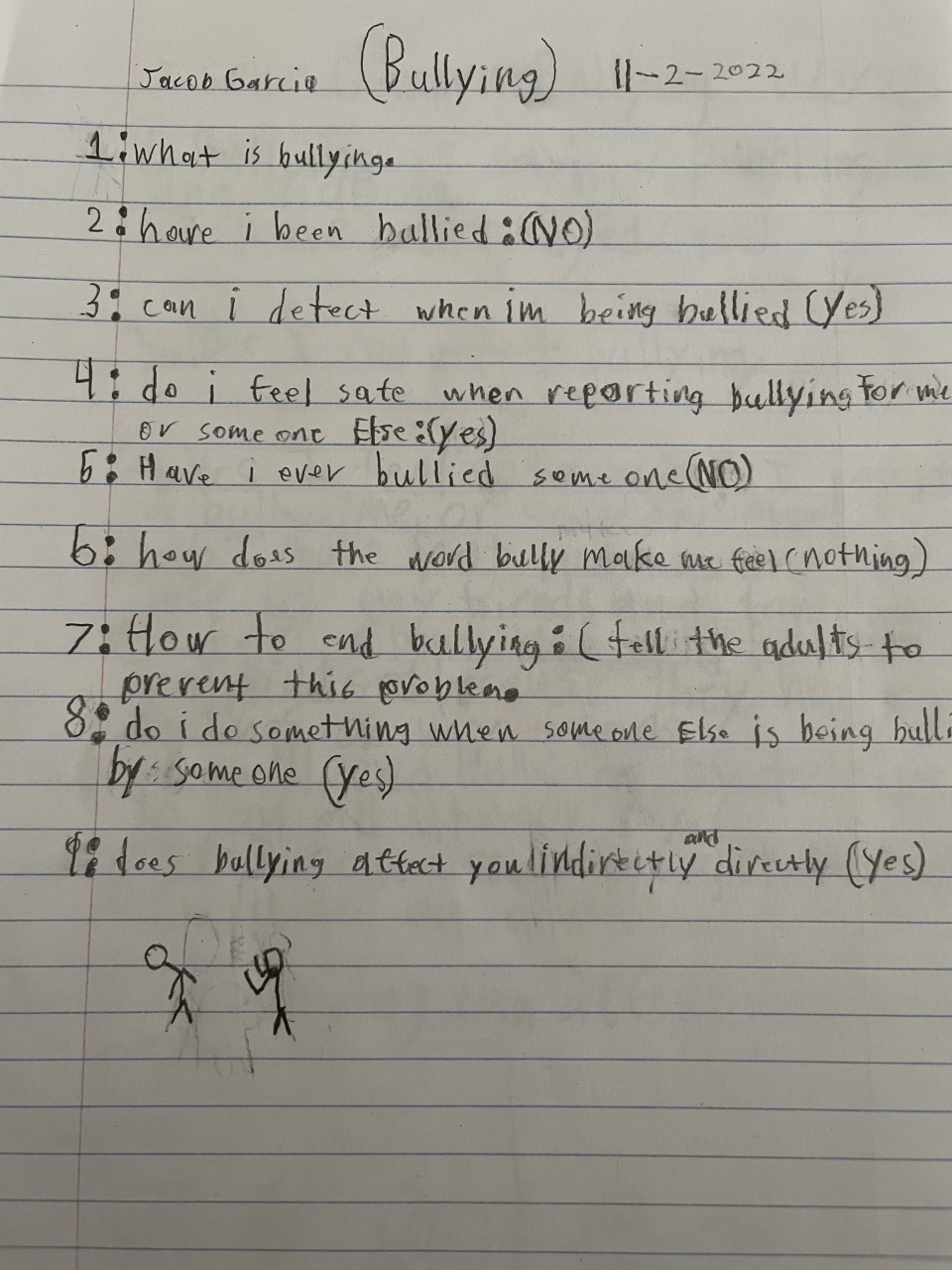
    After reviewing the evidence gathered, 3 out 4 stated that bullying affects them. However, the fourth didn't state yes or no, they stated not really. Not really, is close to uncertainty, but I didn't want the interview to become overwhelming or if I was forcing an answer, which is not the case. I asked the respondents to answer the questions as truthfully as possible and these were the results. However, before they answered whether or not they are affected by bullying I had explained the many ways an individual can get bullied which included indirect and direct contacts or methods of bullying.

✉ Interview Questions:

    What is bullying?

    ✏ Have you ever been bullied before?

    Can you detect bullying?

    Do you feel safe in reporting a bully? For yourself or another?
    
    Have you ever bullied anyone?

    How does the term "bully" or "bullying" make you feel?

    How to end bullying. How would you end bullying?

    Have you ever come across someone being bullied and did you do something about it?

    Does bullying affect you? Are you affected by bullying? Indirectly and/or directly?

    ✏ Task: Draw the term "bully." When you think of the term "bully" or "bullying" what comes to           
         mind?

✉ Testimonial 1: Jacob S. Garcia


✉ Testimonial 2: Jiselle B. Garcia


✉ Testimonial 3: Isaac Gomez


✉ Testimonial 4: Jesus A. Gomez


✉ Group Photo (Interviewees):


Left to Right: Jiselle B. Garcia (9), Jacob S. Garcia (12), Jesus A. Gomez (11), and Isaac Gomez (10).
November 02, 2022

✉ Indirectly Defined:

    ✏ "In a way that is not directly caused by something; incidentally" (Oxford Languages, 2022).

    ✏ "Without having had direct experience; at second hand" (Oxford Languages, 2022).

✉ Directly Defined:

    ✏ "Without changing direction or stopping" (Oxford Languages, 2022).

    ✏ "With nothing or no one in between" (Oxford Languages, 2022).

✉ Questionnaire Explained:

    ✏ Bullying is a sensitive topic, people who may know of someone that is getting bullied or they're
         getting bullied themselves don't open up or admit that the bullying is occurring for a variety of
         reasons and one of them is fear of retaliation. I asked these questions and I asked them in many     
         forms so that the interviewees had a better understanding of bullying and if they don't have any 
         knowledge on the topic bullying then this exercise would bring awareness to the topic. Bullying can 
         happen directly (face-to-face, etc...) and bullying can happen indirectly (rumors, jokes, etc...).

✉ Statistics:

    ✏ "A higher percentage of male than of female students report being physically bullied (6% vs. 4%)"
          (National Center for Educational Statistics, 2019).

    " A higher percentage of female than of male students reported being the subjects of rumors (18% vs. 
           9%)" (National Center for Educational Statistics, 2019).

    "One out of every five (20.2%) students report being bullied" (National Center for Educational
           Statistics, 2019).
                                                                                                                                                     (Pacer, 2020)                                                                                                                                             
                       
✉ The Effects of Bullying:

    ✏ Low Self-Esteem

    ✏ Depression

    ✏ Anxiety

    Sadness and Loneliness

    ✏ Changes in sleeping and eating patterns

    Health Impairments

    Academic Impairments

    Self-Harm

    Somatic Symptoms

    Etc...
                                                               (Stopbullying.gov, 2021) & (Rivara. F. & Le Menestrel. S., 2016)

Why Is This Important?

    The effects of bullying during an individual's child and adolescent years are much more severe than one might perceive. Its not a tease and it wasn't just a shove, this is called bullying. The effects of bullying have the potential of carrying on into an individuals adult years. Bringing awareness and identifying bullying can spare someones life from the trauma and effects that coincide with bullying. Understanding the effects of bullying can help society understand why some individuals are closed off, why they are quiet, why they are seen alone, and so forth; understanding the effects of bullying prevents society from misunderstanding and judging someone who has been bullied and misinterpreting their quietness for being conceited. Raising awareness on this matter will help prevent and hopefully end bullying. 

References

Anonymous. (2022). Child. Oxford Languages. Google.


Anonymous. (2022). Indirectly. Oxford Languages. Google.


Anonymous. (2022). Directly. Oxford Languages. Google.


Anonymous. (n.d.). Adolescent. National Cancer Institute. 

https://www.cancer.gov/publications/dictionaries/cancer-terms/def/adolescent


Anonymous. (n.d.). Adolescent Health. World Health Organization. 

    https://www.who.int/health-topics/adolescent-health#tab=tab_1


Anonymous. (2008). Bullying. American Psychological Association. 

https://www.apa.org/topics/bullying


Anonymous. (2019). How is “direct bullying” different from “indirect bullying”?. Pacer’s 

National Bullying Prevention Center. 

https://www.pacer.org/bullying/info/questions-answered/direct-vs-indirect.asp


Anonymous. (2020). Bullying Statistics. Pacer’s National Bullying Prevention Center. 

    https://www.pacer.org/bullying/info/stats.asp


Anonymous. (2021). Effects of Bullying. Stopbullying.gov. 

    https://www.stopbullying.gov/bullying/effects


Rivara. F. & Le Menestrel. S. (2016). Prevent Bullying Through Science, Policy, and Practice.

 National Institutes of Health.

 https://www.ncbi.nlm.nih.gov/books/NBK390414/


Shonkoff, Dr. J. (n.d.). Why Early Childhood Matters. North Carolina Department of Health and 

Human Services.

https://www.ncdhhs.gov/about/department-initiatives/early-childhood/why-early-childhood-matters


Student Mental Health

 Mental Health Effects on College Students 

Mayra Aparicio Pineda


WHAT IS MENTAL HEALTH? 

Mental health includes our emotional, psychological, and social well-being. It affects how we think, feel, and act. It also helps determine how we handle stress, relate to others, and make choices. Mental health is important at every stage of life, from childhood and adolescence through adulthood. Throughout your life, if you experience mental health problems, your thinking, mood, and behavior could be affected. 

WHAT IS CAUSING A STUDENT MENTAL HEALTH CRISIS?

  • PRESSURE TO SUCCEED 

Many college students feel pressure to succeed academically. The desire to achieve high grades in a difficult academic environment can lead to increased levels of stress and anxiety. Students may overwork themselves and neglect their own well-being, especially if they procrastinate on assignments. Procrastination itself can be a coping mechanism for anxiety about grades.

  • FINANCIAL WORRIES 

Many students must take out loans to afford tuition, room and board and other fees. This can lead to financial worries as students wonder how they will pay back these loans after graduation. The financial cost only increases the pressure to succeed in one’s chosen field. On top of all of this, textbooks and other supplies are expensive. Students may have to work one or more jobs in college to cover these costs. Managing work and school can increase stress levels and anxiety, as well as take away from your time to sleep and relax.

  • UNCERTAINTY ABOUT THE FUTURE

Many students enter college without deciding on a major. Even those who have declared a major may not have a clear idea of what they want to do with their degree. This indecision and lack of direction may lead to anxiety or even depression. Our society promotes the idea of immediately entering college after high school, and then immediately starting a career after college. Unfortunately, this can cause stress for students who need more time to decide what career path they want to take.

  • DECREASED STIGMA

What we see as a mental health crisis might be due to an increase in students seeking mental health services. Some researchers believe that the rates of mental health concerns are about the same as they have always been, but more students are open about their struggles and are more willing to seek treatment. Regardless of what is causing the mental health crisis, colleges and communities should work together to address students’ concerns.

RESEARCH

A person's university years are more emotionally and academically challenging than almost any other period of their education. An individual experiences numerous obligations and obstacles at this time, which can lead to a wide range of physical, social, and emotional concerns. In the article titled, Exploring the relationship between mental health-related problems and undergraduate student dropout: A case study within a civil, the authors A.A. Del Savio, K. Galantini, and A. Pachas conducted a research regarding mental health and higher education. They found a study which stated:

"in the USA at four universities showed that 40% of their students have at least one mental health-related problem (Lipson and Eisenberg, 2017). Similarly, 59% of the students at a Canadian university have moderate to high levels of depression, and 56.3% reported the same in anxiety levels (Suresh et al., 2021). In a Spanish university, 34.9% of the students evaluated had symptoms of depression; 39.6% symptoms of anxiety; and 28.8%, symptoms of stress (Blanco et al., 2021). Other research found depression in around 13% of the studied population of undergraduate students (Hossain et al., 2021). Women are more likely to develop depression, anxiety, distress, and stress symptoms than men (Ibrahim et al., 2013Elmer et al., 2020). Finally, the WHO estimates that, among higher education, the average rate of depression is 1 in 20, that is, 5% of the general undergraduate and graduate population (WHO, 2012)."

COVID-19 EFFECTS ON MENTAL HEALTH 

A recent issue that has caused students to suffer with mental health has been the pandemic which began in 2020. During the beginning of COVID-19, students had to quickly adjust to the changes of going remote. Going remote put a lot of stress and anxiety on students. The article titled, Remote Learning and students’ mental health during the Covid‐19 pandemic: A mixed‐method enquiry, by S. Lischer, N. Safi, C. Dickson, conducted several surveys. The data they received showed that some students were able to manage with the changes, however other students "expressed difficulties in concentrating and maintaining the necessary motivation for distance learning". A common condition that caused this was not having a private study location from home. Moreover, having to learn and communicate exclusively online made some students nervous, stressed or anxious because of technical problems. 

In another article titled, In-Person Instruction or Remote Learning?: Understanding Students' Learning Experiences during COVID-19, by E. Marquez and S. Garcia surveyed students to identify what for of leaning they preferred. A student mentioned they felt it "was incredibly important to meet people. It kept  [them] from feeling isolated and helped [them] make friends who [they] could study with." In addition,  returning to in person lectures was a welcome modification that made students recognize the importance and worth of human engagement. A student shared the following: “It is very important to have face-to-face interaction with people because it is the only way to actually develop relationships with people. I feel like I met a lot people this year virtually but never actually got to know them. Really only their names and maybe very few basic things.”. At the beginning of COVID-19 most students felt like they lost that connection between other students, resulting in a feeling of loneliness. Although, going back in person had its pros, it also had its cons. Some students felt anxiety of gettin sick and getting their families sick as well. Students also felt a pressure of readjusting to being face-to-face. 

CONCEQUENCES 

  • -Peers, family members, faculty, and staff may be personally affected out of concern for these students.
  • -Depression and anxiety can have harmful effects on relationships and work productivity.
  • -Suicide and suicidal thoughts can affect the larger campus community.
  • -Roommates, peers, faculty, and staff also experience profound grief over student suicides and suicidal   behavior.
  • -Campuses feel the burden when students with mental health difficulties do poorly on course work and      drop out of school.
  • -Colleges and universities must be prepared to address the psychological impact of suicides on other students, as well as on teachers and staff.
  • -Poor student retention can mean losses in tuition, fees, and alumni donations.
  • -The community is negatively affected when students are unable to finish their degrees and contribute valuable skills in a competitive job market.

PERSONAL VIEW 


Student mental health is an important issue for me because it is something that I deal with personally and believe is an important issue in my community that should be addressed. Going into college I did not know what to expect, but after going through my college journey and now being a senior, I have seen and experienced a lot. I have felt a lot of stress, pressure, anxiety, and depression during my years in college. I often feel a pressure to succeed not only for myself, but for my parents and younger siblings as well. Being the oldest in my family means I have to be the best version of myself in order to become a positive role model for my younger sisters, which can be difficult when I cannot always be perfect. Growing up in a hispanic household, I often had to learn to become independent at a young age and teach myself. This has made it difficult for me to seek for help in situations that I need it the most. Not learning to get help has been hard on me because I end up putting so much weight on myself that I cannot carry on my own. However, I do believe it is important to ask for help when needed and I am learning to become better at that for the sake of my own mental health.


STUDENTS AFFECTED BY MENTAL HEALTH

Bernardo Garcia 
"I often feel stressed or overworked and wish I knew how to manage by school work better"

Krystal Manriquez 
"whenever I'm on campus I tend to become anxious, this causes me to lose focus during my classes and effects my performance in school"

Victoria Perez 
"being a freshman in college makes me anxious because I have to adjust to the new changes and learn to manage my time. I have recently felt very stressed and overwhelmed and I tend to not get much sleep, which has effect my mental health a lot"

WHY STUDENTS SHOULD HAVE MENTAL HEALTH DAYS | HAILEY HARDCASTLE


STRATEGIES TO IMPLEMENT THROUGHOUT THE WEEK TO IMPROVE YOUR MENTAL HEALTH


RESOURCES FOR MENTAL HEALTH
  • iPrevail 

  • Suicide and Crisis Lifeline


SOURCES 

Lischer, Suzanne, et al. “Remote Learning and Students' Mental Health during the COVID-19 Pandemic: A Mixed-Method Enquiry - Prospects.” SpringerLink, Springer Netherlands, 5 Jan. 2021, https://link.springer.com/article/10.1007/s11125-020-09530-w. 

Marquez, Eleazar, and Samuel Garcia. University of Texas Rio Grande Valley Scholarworks @ UTRGV. 23 Aug. 2022, https://scholarworks.utrgv.edu/cgi/viewcontent.cgi?article=1082&context=me_fac. 

Savio, A.A. Del, et al. “Exploring the Relationship between Mental Health-Related Problems and Undergraduate Student Dropout: A Case Study within a Civil Engineering Program.” Heliyon, Elsevier, 25 May 2022, https://www.sciencedirect.com/science/article/pii/S2405844022007927. 

“Why Students Should Have Mental Health Days.” YouTube, TED, 4 June 2020, https://youtu.be/1qq7lDL-bzY. Accessed 6 Nov. 2022. 

Food Waste


-Research-

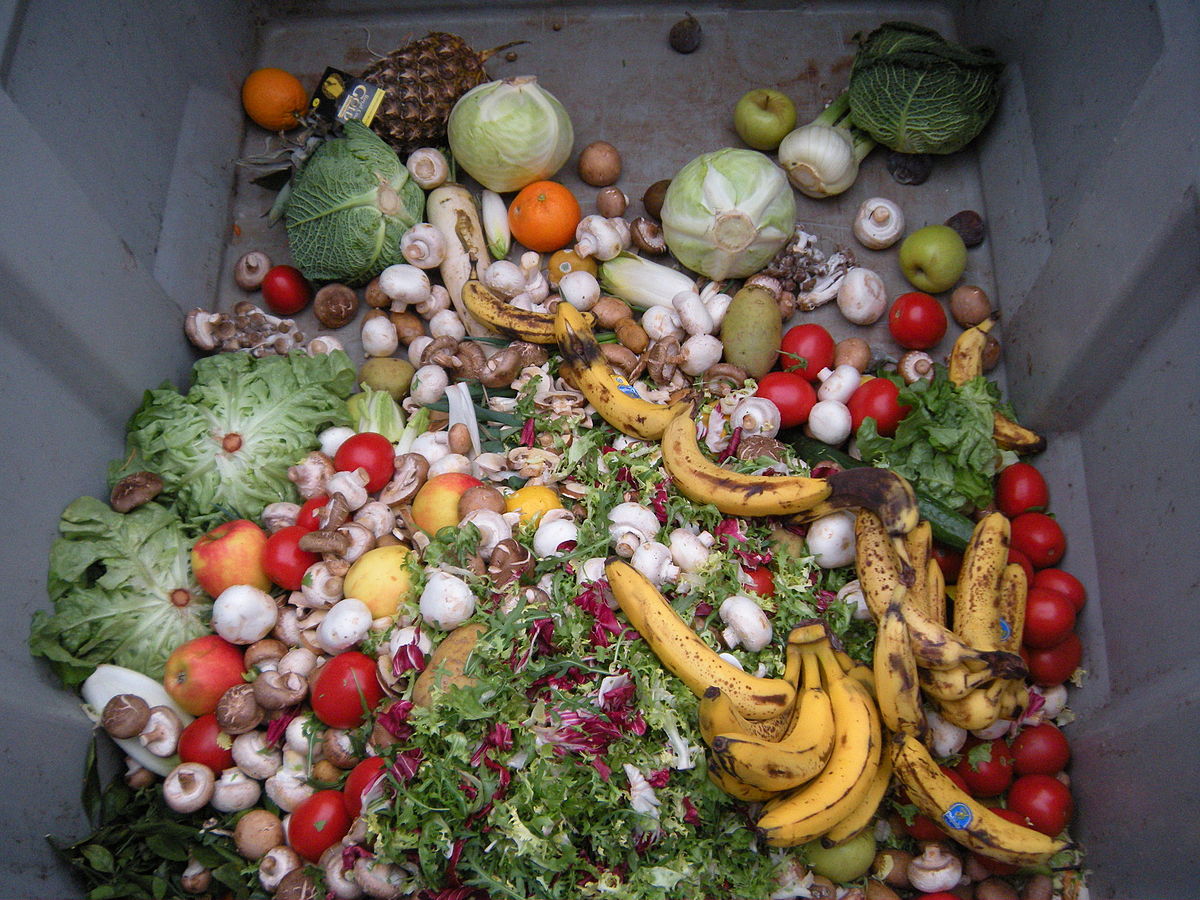
What is food waste? The general consensus is that food waste is food that was meant for and considered safe for human consumption but is ultimately thrown away. This could be food that is uneaten at restaurants, food that has reached an expiration/"best by" date, food not meeting a quality standard for retail, manufacturing errors, or crops not completely harvested and sold. There is multiple different definitions as to what is food waste or loss is, the common thing tying these together being at the end of the day, food is thrown out. Pictured below is a table with various organization's definitions as to what food waste is.


Source: Definitions of Food Loss and Waste, Understanding Food Loss and Waste -- Why Are We Losing and Wasting Food? Proceedings of the Institution of Civil Engineers-Waste and Resource Management

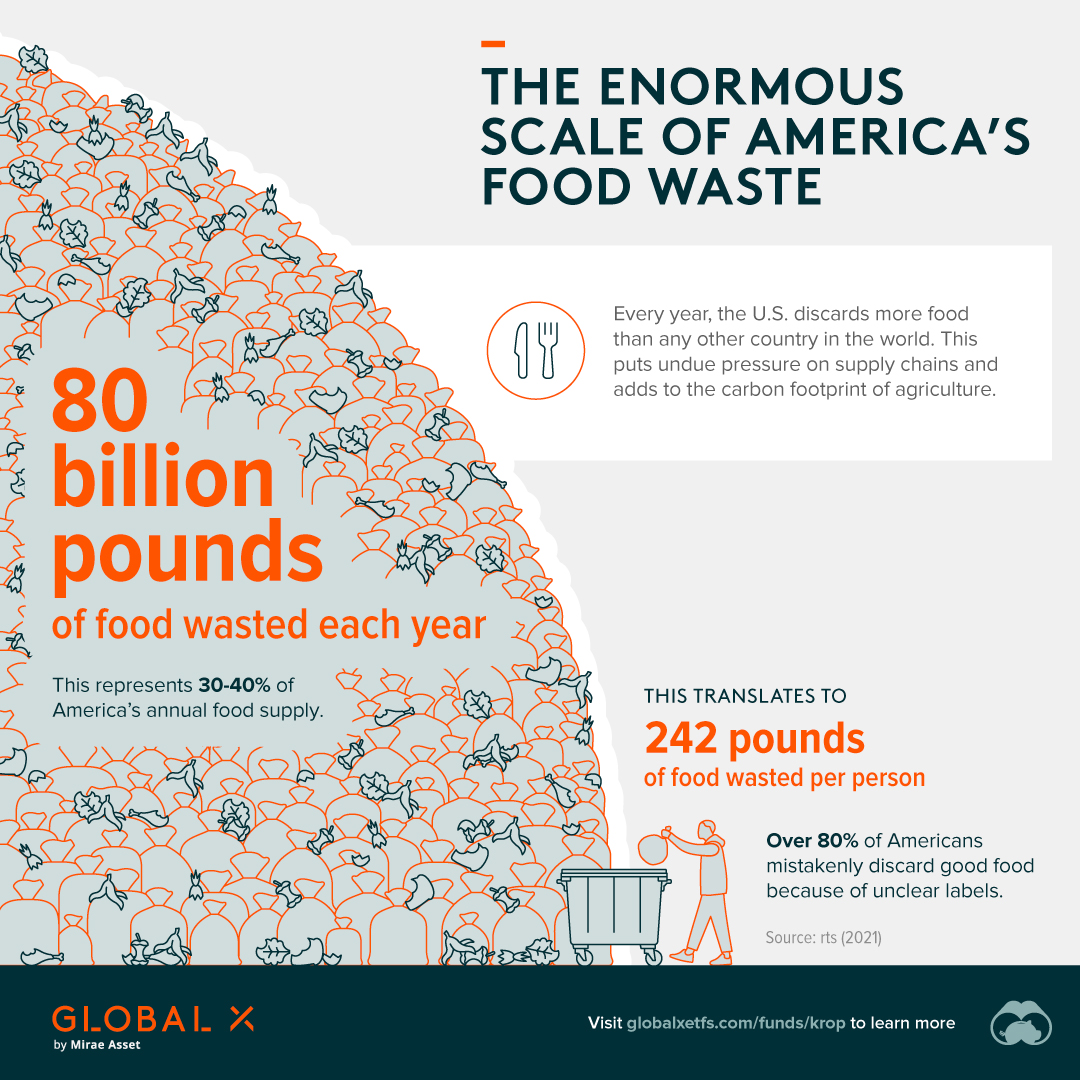
The next thing to ponder is how much food is being wasted or thrown away? According to the US Department of Agriculture, "food waste is estimated to be between 30-40 percent of the food supply", and based on the estimates from the USDA "31 percent [of] food loss [from] the retail and consumer levels [...] this is added up to approximately 133 billion pounds and $161 billion worth of food in 2010". A decade later, and it seems that things have not gone down, it seems we are still wasting food on a larger scale. Most people are not aware of food waste nor the consequences of it as households are the biggest provider of food waste along with retailers.


What consequences does food waste have on the globe? According to the Environmental Protection Agency, food waste is one of largest single categories of waste in landfills. Food tends to decompose faster than other waste products via anaerobic species of bacteria. A byproduct of this decomposition is the production of methane gas, and extremely potent greenhouse gas. While livestock and oil/gas production are large producers of methane gas, so are landfills via organic waste decomposition. It is important to understand that methane gas is far more potent of a greenhouse gas than carbon dioxide, having a 25% higher global warming potential.

Not to mention food waste is a significant waste of resources, especially for agriculture as food lost still had to be grown on land, harvested, packaged, transported, etc. only to be thrown out. There has been the quiet whispers of a food shortage on the horizon, that there are so many who are starving and need food. This begs the question, if there's an excess of food waste, then why is there a food shortage crisis in the first place? There is a lack of awareness and very little discussion on the subject of food waste, perhaps with more awareness something can be changed for the better soon.

-Personal-


I find that food waste is something that does affect everyone on a personal level. After all most of food waste comes from households tossing food as well as retailers disposing of uneaten or expired food. We as people also contribute to this problem and I have been guilty of it in the past. However, working in the service industry has made me realize that there is a huge issue with disposing still viable food at the end of the weekend. There is massive quantities of food and drinks that are produced with the hopes that it will be consumed by customers within the end of the week. Once Sunday has been  reached we are told to throw away all the food and drinks that weren't consumed if they were prepared by me or my coworkers. Canned goods wait until the expiration date is reached before they are tossed. Regardless, seeing the quantity of food waste being disposed of makes me wish that there was something that could be done instead of it all being thrown out. Nowadays, I don't enjoy seeing food be thrown out and if I can take excess work food home I absolutely do. However, the chance to do so isn't always available nor does every establishment allow for food to be taken home. Ultimately after seeing it and tossing out viable food myself, I am left wondering what can I do? Could there be changes to how food waste is handled?

-Community Interaction-


I decided to speak with various individuals on Cal State LA's campus and asked them if they knew what food waste was, what their thoughts on the subject is, and if they could do something about it, what would they do? Some having worked in the service industry did, some did not, but regardless these were some of their responses:


"Food waste is only exists because there is a vested interest (the profit motive) for keeping the supply of food and availability of it as minimal as possible. If the country were more interested in providing for its citizens and ensuring an adequate quality of life with appropriate access to food, it would enact legislation to limit food waste or penalize companies for disposing of food. Ultimately there is an extreme excess of food that is thrown away per day, that is still usable, and the only true excuse that lawmakers and the public alike even tolerate is that it's challenging to distribute." -Chase Hooper


"Food waste is something that is overall pretty upsetting to me. I always hear about fast food places and restaurants throwing away all of their food at the end of the day and refuse to give it to those in need because of “not making profit” off of it. I used to work at a fast food chain and my former boss terminated people for giving away food that was already going to be thrown away. I hope that one day something can be implicated to donate all this food to different food banks and/or shelters instead of wasting tons of it everyday." -Hannah Lumapas-Noragong


"It makes me feel sad, there needs to be a mechanism in place for food to be transported from restaurant or grocery store to where other people can acquire. Whether that is a food bank or other institution." -Susan Cohen

-What Can Be Done?-


We, as a people can make efforts to reduce the amount of food waste we produce and be mindful about how much food we dispose of. It is also good to know that there are various organizations that are striving to make a change regarding food waste. Feeding America is an example of an organization that is striving to recuse food from dumpsters and prepare it for those who are facing hunger. They work with retailers, farmers, and manufactures with handling food loss and preparing it as quickly as possible. They also strive to donate viable food to food banks to try and help feed as many people as possible. This is the largest organization to do something, but that does not mean there aren't others out there trying to make a difference. World Food Program USA is another that is not only trying to solve hunger in the USA, but also globally, working with farmers, schools, and communities to provide food, educate about reducing food waste, and provide relief when disaster strikes.

Ultimately, raising awareness, supporting organizations that fight to reduce food waste, and reducing our own personal waste are the best ways to take action. Perhaps in the future with enough awareness, we as a community can reduce both world hunger and food waste.

-Sources and Further Reading-


Thursday, November 3, 2022

Mental Health in Mothers Post Pandemic by Courtney Corral


 The Covid-19 pandemic was an uncertain experience for everyone across the globe. It was an especially uncertain and emotional ride for expectant mothers. These women juggled the fear of contracting this new virus and passing it to their baby, the stress of working at home isolated from their peers, and, for some, the burden of acting as a teacher for their other children who were doing schoolwork remotely. Add on cooking and cleaning, and it's no wonder why mental health problems in mothers have been at an all-time high since the pandemic began. Lives were flipped upside down. When restrictions began lifting, these women still had the responsibility of caring for a baby while an unknown virus was quietly making its way around town. Moms struggle with the burden of leaving their child, or children, for hours at a time. Some return to the office, others to their education, all while having to look for daycare openings or family babysitters. It's important to be aware of the situation at hand in order to support a mother in need in your own community. Studies show,  


❤Since the onset of COVID-19, mental health issues have increased among postpartum women, with 41 percent reporting depression and 72 percent reporting moderate-to-high anxiety (compared to 15 per cent and 29 per cent pre-pandemic).

❤Depression is the most predominant mental well-being issue during pregnancy, associated with side effects such as a discouraged state of mind, low confidence, loss of interest, sensations of uselessness, peevish temperament, loss of hunger, feelings of weakness, and lousy concentration abilities

❤ Maternal mental health disorders lead to negative lifelong consequences for mothers, infants, and families.

❤ Effects can include premature delivery, reduced mother-infant bonding, and developmental delays in infants.


    During June of 2020, in the middle of the pandemic, I found out that I was pregnant. I slept in every morning, danced around my apartment while cleaning, and took so many naps. On February 28th, 2021, I delivered a healthy baby girl. Around this time, Covid restrictions began being lifted, and the world started getting, somewhat, back to normal. This is when the reality of being a mother began to sink in. I wasn't a 26-year-old food server anymore, having drinks, or a smoke, after a hard shift with co-workers. I was now a 28-year-old, stay-at-home mom who spent every morning at the park and every afternoon watching Sesame Street. When I reached out to friends, they would text back "I'm at work", and when I called my partner, I'd get the same response. 
I missed the connection I used to have in my old life. When I would get the chance to go out, it definitely wasn't the same. I needed to find a way to feel just a little bit like my old self again. So, I decided to look online for help. I joined a few Facebook groups for new moms and started building connections with women online who were in the same boat as me. We shared our feelings and experiences, and it felt so great to know that I wasn't the only one feeling this way. We talked about ways to beat the negative thoughts in our minds, like taking our little ones for walks. We were also there to support each other when one of us needed someone to talk to. Struggling with mental health alone is scary, but when you find the right support group, your mind can overcome anything.                                    


Christina Valdivia (28), First Time Mom

 "During the pandemic, I decided to finish my education. My son was 1 year old, so I thought it was the perfect time. Wrong. He started to climb on things and wanted my undivided attention. To top it off, the people in my class were so much younger than me. I felt embarrassed and overwhelmed. It was driving me insane, but I did this to myself, so I needed to get through it."


Sarah Pena (28), Mother of 2

"With my first daughter, I was in a walking group that would meet every Friday at the park for an hour with our little ones. This time around, everyone was too scared to be outside, let alone be outside with our babies. I felt really alone and missed my Friday walks. The pandemic really took away the bond I felt with other moms during my first pregnancy." 


Francine Garcia (27), First Time Mom 

"At work, you're surrounded by people but still feel alone. Then, you get home and your babysitter leaves. So, you're alone again with your kid, who you love so much, but can't have a conversation with. Alone again, waiting until your partner gets home to have an adult conversation. By that time, they're tired of working all day and don't take into consideration that you're also mentally exhausted and still have to be a mom."


    Now that we are aware of the issue, what can we do to help? Helping a mother in need could be as simple as making as phone call or sending a text message. It's important to let your friend know that they are still on your mind. Physical activity is also a great way to exercise one's body and mind. Going for a walk with a friend is a great way to express yourself and get fresh air. One could also recommend that their mom-friend join an online support group. 

 ❤ Activities such as gardening, going for walks, household chores, and online fitness classes are feasible alternatives to promote wellness through movement and should be promoted as reasonable methods for increasing the physical activity of moms.

Frontiers | Moms Are Not OK: COVID-19 and Maternal Mental Health (frontiers 

❤ As little as a single group exercise session of 45 minutes can improve anxiety levels in women without a history of mental illness.  


Homelessness in Los Angeles by Karen Cruz

 Homelessness in Los Angeles

Karen Cruz


    When you think of Homeless you might think about homeless in your neighborhood or community. The biggest area where you will find more homeless in the city of Los Angeles is Downtown. Homeless in Downtown Los Angeles has taken over most areas of the city making it easy to be seen when passing by in a car, on public transportation, or even walking. Homelessness has been an ongoing issue in Los Angeles making it considered a major social issue. 


    Here are some reasons why individuals become homeless:    

  • They are having trouble affording or finding affordable homes
  • They want to escape their past if they experienced some type of domestic violence 
  • Teenagers who have run away from home
  • They could have a mental health issue or disability
  • and etc...

    In the article "Growth in L.A. County homeless population slowed during pandemic, count finds," by Ruben Vives and Doug Smith talk about the count of homeless in L.A. and how it has slowed down during the pandemic. In the article, they both shares, "The Los Angeles Homeless Services Authority, which coordinates the annual count for most of the county, found that the region's homeless population grew by 4.1% from 66,436 in 2020 to 66,144 in 2022. The percentage of those individuals living indoors in shelters increased from 28% to 30%" (Vives and Smith). What I think about this information is that the amount of homeless has increased more in the year 2020 especially when the pandemic started to hit. The pandemic has been a major factor in making the homeless population grow because when the pandemic started the state declared everyone to stay home and quarantined making the people who worked lose their jobs and have trouble living their life when everything was close. 

    In the article "Los Angeles county is home to more than 69,000 unhoused people, count finds," by Sam Levin, he talks about the count of homeless in L.A. and also talks about racial disparities that are along the homeless population. In the article, he shares, "There continues to be severe racial disparities in the crisis, with Black residents making up 30% of unhoused Angelenos, while accounting for only 9% of the broader population. There has also been a substantial increase in unhoused Latino residents, who now make up 44% of the unhoused population. Latinos make up 49% of LA county residents" (Levin). It is important to consider the races in the homeless population because it can help out determine what was the issue of the individuals becoming homeless. I think the reason why we have more Black and Latino residents unhoused is that there have been imbalances for the individuals of those races going on. For Black, there is racism and injustice towards them and for Latinos well, the case is that they are most likely immigrants and they are having trouble finding a job and shelter. 

Personal Importance

    This social issue is important to me because no one deserves to be homeless and they deserve to have a safe and warm place to live. I feel personally affected by this social issue because in my neighborhood homeless have taken over an entire sidewalk by the grocery store which does not make it safe for the rest of the people since we have to basically walk on the street. Sometimes they bring more trash and basically almost take over half the street making it not safe for cars to pass by and people to walk to the grocery store. The reason why I choose this social issue is that I feel like homelessness needs to be talked about more and there should be more ideas on how we can encourage those who live on the streets to go live in the shelters that were made for them. If we all come together we can get more helpful ideas to get the homeless out of the streets since it's not safe for them to live in the streets. Homeless run the risk of dying of natural causes, the cause of climate change or getting hit by a very dangerous accident. 

Those Affected in the Community


"Homeless need a safe place to sleep especially right now the weather is getting colder at night." -Lesly Cruz


"Getting homeless and everyone else a safe place should be important." -Roberto Ramirez Garcia


"I think homeless people who live on the street have certain limits in their health plan, for example, there are times when they are sick and have nowhere to go because of their appearance, food for them is also limited because there sometimes they don't have anything to eat, they struggle to have food on the table, it's sad and now that I see many homeless people on the streets of Los Angeles, it makes me sad to see that there are many more young boys, now I remember that in 1999's there weren't many people but now after 25 years, it is something that one sees and is surprised. I hope that the homeless find a home because they deserve to live in a house where they can sleep in peace and not have to worry."- Elvira Valencia


Resources 

Levin, Sam. "Los Angeles County Is Home to More than 96,000 Unhoused People, Count Finds." The Guardian News
and Media, 8 Sept. 2022, https://www.theguardian.com/us-news/2022/sep/08/los-angeles-homelessness-unhoused-people-number.


Vives, Ruben, and Doug Smith. “Growth in L.A. County Homeless Population Slowed during Pandemic, Count Finds.”
Los Angeles Times, Los Angeles Times, 8 Sept. 2022, https://www.latimes.com/california/story/2022-09-08/l-a-county-homeless-count-shows-homelessness-grew-slightly-a-possible-sign#:~:text=The%20Los%20Angeles%20Homeless%20Services,from%2028%25%20to%2030%25.

Wednesday, November 2, 2022

Cal State La Garden Project

Garden Project: Cal State Los Angeles by Scott Cardona

 Sources

Step 1: Research

1) https://www.treehugger.com/california-native-plants-5194043

2) https://www.latimes.com/lifestyle/story/2022-02-19/drought-tolerant-plants-dry-weather

3) https://www.lvmwd.com/home/showdocument?id=711

ECONOMIC CHALLENGES!

2) https://water.ca.gov/News/News-Releases/2022/Sep-22/DWR-Takes-Actions-to-Support-Future-Water-Supply-Strategy

INDIVIDUAL CHALLENGES!

Step 2: Personal

The social and economical aspect to this project that's pertains to me personally also effects everyone in California. We are headed into and may already be far into climate change where it is irreversible now unfortunately. This Civil Engagement project has made me think about our future here in Los Angeles. We are running out of water and we need to now take into consideration how we will find a source of food and or nutrition. We cant afford to exceed our resources on these plants and vegetables that need large amounts of water and care to exist. I realized that there are many plants in our state that are not native to California. Not only are they intrusive to our native plants. They take much more water and care to strive in our ever changing climate. In the near future we will need to have the knowledge of which plants can resist droughts and heat to be able to sustain themselves and us.

Gathering Evidence


Amber Castillo-"We need to learn how to grow our own vegetables again!"

Jennifer Busch: "With climate change happening as we speak we need to take into consideration how humans will survive and adapt to this situation."

Nicole Goodman: "With California statistically loosing percentages of water ever year, we need to prepare for our future and how we will be able to strive."

Mana Ahuja: "Climate Change is irreversible now and planting drought/heat resistant plants will help save and change our future for the better."


Dissemination of research to a public audience 

  • It is stated that California has started to lose 10% of its supply of water every couple of years.

  • Significant increase in global temperature. 

  • Most people do not know how to care or build a self sustaining garden.

  • High rate of intrusive plants in California

I feel as if this subject needs to be touched on and spread to the masses. California has obviously increased in temperature and global climate change is indeed real and upon us. The only real solution is to take into consideration how this country was originally cared for before we intruded ourself onto the soil. There are over 100 native plants and vegetables that grew organically and locally throughout California. A small garden plot was able to feed a whole civilization based on the native plants and vegetables that grew in the area. The are techniques that the indigenous people practiced that would sustain and bring the nutrients. There is a garden in Cal State La located near the Student Housing building. I brought it upon my self to introduce and plant 8 native California plants into the garden. Hopefully when those plants grow enough we can start to clone them and spread them all across Los Angeles and share our information on drought and heat resistant plants.